
The Properties of the Coffee Plant: What Does a Coffee Plant Look Like?
Everyone knows what coffee looks like. When we hear the word “coffee,” we usually think of the delicious drink we enjoy. And if it’s not the exquisite, energizing beverage that comes to mind, then it’s often the brown coffee grounds or the coffee beans that we imagine.
When we think about what coffee looks like, we might not actually be aware of its true appearance. That’s why I’ve gathered a few images to show coffee in its real form. Let’s take a closer look at the coffee tree, or coffee plant.
Appearance and Characteristics of the Coffee Plant
The coffee plant begins to bloom after many months. The white flowers later develop into the fruit known as coffee cherries.
The coffee plant is truly a beautiful and elegant-looking plant, which at first glance might seem more like an ornamental plant than a crop that provides the morning drink for millions of people worldwide.
A coffee tree or coffee plant usually grows 6–13 feet tall, but in its natural environment, in shady forests, it can reach heights of over 33 feet. Growers, however, typically prune the plants and keep them around 5–6.5 feet tall, making harvesting easier and allowing the plant to direct more energy toward ripening the fruit.
The coffee plant’s appearance is defined by its dense, glossy, vibrant green leaves, which give a healthy and lively impression even from a distance. The leaves are elongated, slightly wavy at the edges, and feel thick and leathery to the touch. Their surfaces are often shiny, as if coated with a natural wax layer, which helps retain moisture and protect against harsh sunlight. The leaf veins are distinct and clearly visible, especially in Arabica plants, where the veining forms a net-like pattern on the leaves.
Coffee plants are usually planted in the shade of taller trees, which helps protect them from strong sunlight.
The White Flower of the Coffee Plant

One of the coffee plant’s most remarkable features, however, isn’t found in its leaves — it’s in its flowers. The coffee flower is a true jewel of the tropics: pure white, star-shaped, and reminiscent of jasmine in appearance. The flowers are not only beautiful but also incredibly fragrant. Anyone who has ever stepped into a blooming coffee plantation will immediately remember the sweet, jasmine-like, slightly citrusy aroma that fills the air.
Blooming mainly follows the rainy season and is always a spectacular sight. Coffee flowers usually open in clusters at the base of the leaves, forming almost a wreath around the branch. Since each flower remains open for only a few days, the blooming period is short but all the more magical.
Interestingly, coffee flowering is fairly predictable, following the weather: dry periods are often suddenly interrupted by rainfall, triggering hormonal changes in the plant that cause it to bloom. After flowering, the process of fruit formation slowly begins. In place of the white flower, a small green berry appears, which over the course of several months ripens to red — this becomes the coffee cherry, containing the coffee beans.
It’s important to remember that a single coffee plant can produce thousands of flowers in a year, but not all of them will develop into fruit. The flowers are sensitive to temperature, humidity, and intense sunlight. Excessive heat or unusual cold can significantly reduce the harvest. The coffee plant is therefore not only beautiful but also a delicate and demanding plant, with every small detail — the shine of its leaves, the fragrance and fleeting nature of its flowers—contributing to the creation of the aromatic drink that ends up in our cups.
Properties and Structure of the Coffee Cherry
Coffee cherries start out green, like most unripe fruits.

The coffee cherry is the most iconic and exciting part of the coffee plant, and it’s much more than just a shell around the coffee bean.
In fact, it’s a small fruit that resembles a cherry in appearance, though usually smaller — roughly the size of a large blueberry. The fruit takes months to develop: from flowering, it needs about 7–9 months to fully ripen and turn a vibrant red. At first, the coffee cherry is always green, just like most unripe fruits. As it matures, it gradually passes through various stages, turning yellow, then orange, and finally a deep ruby red.

Although red is the most common color, in some varieties fully ripe cherries can be dark burgundy or yellow. The color therefore depends on the variety and environmental factors, but the surest sign of ripeness is the characteristic, plump texturen—na cherry that is too hard or too soft is usually not optimal.
Coffee Cherry Anatomy
The coffee cherry is made up of several layers, each playing an important role in the quality of the coffee later on. The outer skin of the fruit — the exocarp — is thin, firm, and slightly waxy to the touch.
Beneath this is the pulp, which when ripe is sweet, soft, and juicy. Many coffee producers say that a perfectly ripe coffee cherry tastes like a mix of watermelon, mango, and grape — which is why local children in many regions often eat it fresh.
Under the pulp is the mucilage, a sticky layer that is very sugary and plays a crucial role in the coffee fermentation process. This layer gives many coffees their natural sweetness, contributing to the unique flavors that are highly sought after.
Below the mucilage is the parchment layer, a hard, yellowish-white membrane that protects the raw coffee beans inside. Often, this parchment is only removed at the end of the drying process.
Beneath the parchment is the thin silver skin, which usually falls off during roasting or just before it.
Finally, at the core of the fruit are the coffee beans — typically two flat seeds facing each other. Sometimes, however, a cherry contains only a single seed, known as a peaberry, which is rare and often sold separately.
The coffee cherry is valuable not only for its beans: its pulp is increasingly being used. While it was once often simply composted or used as animal feed, today people recognize that the pulp and mucilage are rich in nutrients and antioxidants. The most popular use is cascara — a tea made from the dried coffee cherry husk — which has a sweet, lightly fruity flavor and serves as a unique alternative to traditional teas. In some countries, it is also used to make jams, syrups, or even as a base for beer or kombucha. From a sustainable coffee processing perspective, using the whole fruit is important, as it reduces waste and ensures more of the fruit is utilized.

Layers of the Coffee Cherry – Briefly
- Outer skin (exocarp) – red when ripe.
- Pulp (mesocarp) – sweet and sticky.
- Mucilage – plays a key role in the fermentation process.
- Parchment layer – paper-like protective layer around the bean.
- Silver skin – thin membrane on the surface of the bean.
- Coffee bean(s) – usually two crescent-shaped seeds.
The coffee cherry is therefore a fruit with intrinsic value, rich in nutrients, and plays an important role in the flavor profile of specialty coffees. How the fruit is handled, processed, or used fundamentally affects the aromas in our cup — making every layer of the cherry a part of the coffee’s story.
The Journey to Brown Coffee Beans

Green Coffee Bean
The raw coffee bean — or green coffee — looks completely different at first glance from the roasted coffee we grind into our daily cup. The green coffee bean is the seed extracted from the coffee cherry before roasting, obtained after removing the fruit’s pulp and drying — whether the cherries were processed using the dry (natural), wet (washed), or honey method.
All of these methods start with the same meticulous work: freshly picked red coffee cherries are processed through mechanical or fermentation methods to remove the outer skin, pulp, and mucilage, leaving the two small oval seeds — the coffee beans — exposed and ready for roasting.
Before roasting, coffee beans are typically a dull green, sometimes with bluish-green or yellow-green hues, depending on the country of origin, the processing method, and how freshly they were dried. They feel hard — almost stone-like — and have a matte, slightly waxy surface. Their shape is characteristically oval, with a longitudinal groove running down the center.
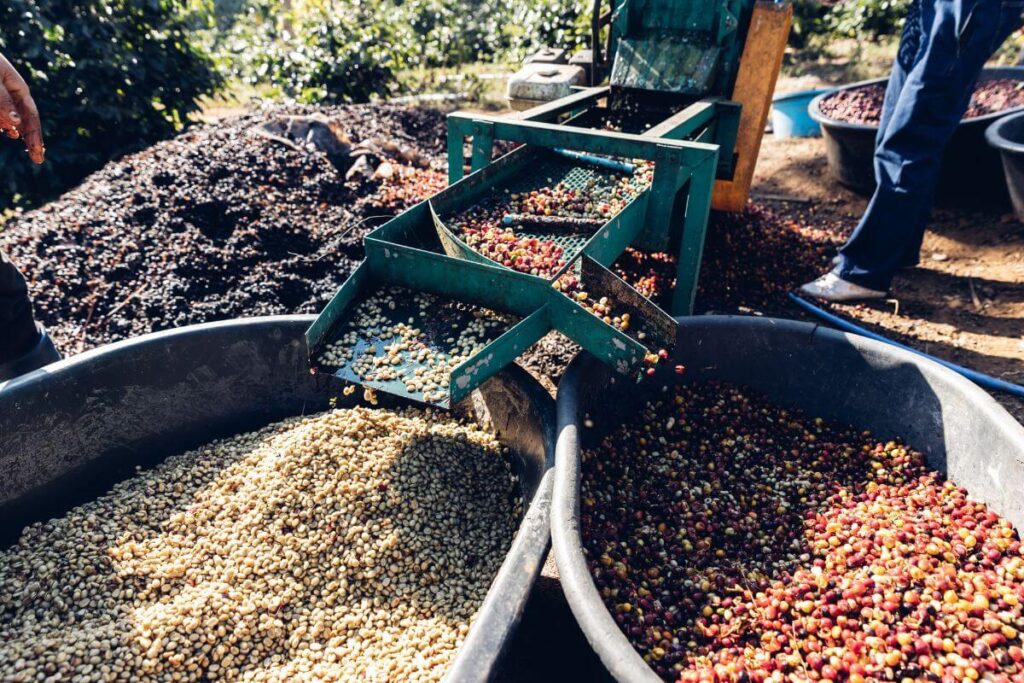
Green coffee beans also weigh more than roasted beans because they contain more water and have a denser structure. Their aroma is mildly vegetal, grassy, and sometimes slightly sweet, with none of the flavor notes that roasting later brings out. Green coffee is ideal for storage, trade, and long-distance transport, as this helps preserve its quality until it reaches the roastery.
Roasted Coffee Beans
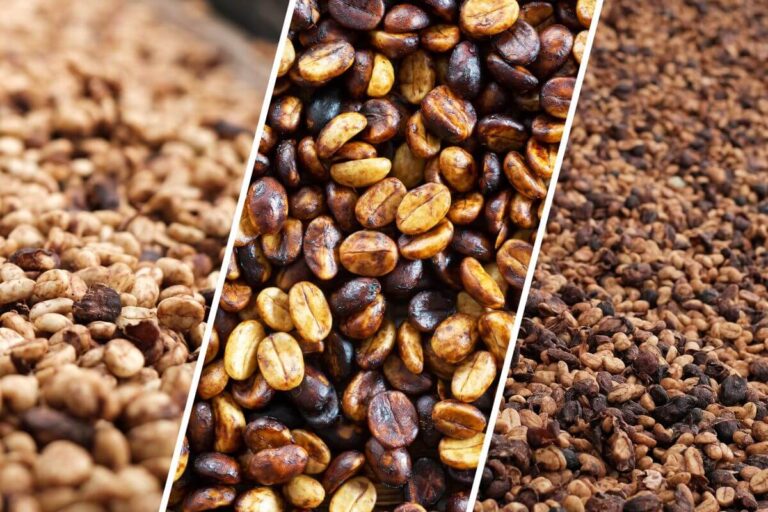
Roasted coffee beans, on the other hand, are completely transformed: they are darker, shinier, and much more aromatic. During roasting, the water in the green beans evaporates, the beans expand, their structure loosens, and their color can range from light brown to an oily, dark chocolate brown. The central groove (crease) opens up, and depending on the roast level, the surface of the bean can be dry and matte or shiny and oily.
The aroma of roasted beans is intense and complex, carrying the sweetness of caramelized sugars, as well as notes of roasted nuts, chocolate, and sometimes fruity hints. Roasting doesn’t just change the color and aroma—it creates hundreds of flavor compounds that form the foundation of coffee’s taste. To the touch, roasted beans are much lighter and more brittle than green coffee beans, which makes grinding easier.

While green coffee is the raw material, a mere promise of a delicious, energizing drink, roasted coffee beans are the fulfillment of that promise. This is the form from which espresso, drip coffee, or any other brew can be made. The transformation between these two states is one of the most fascinating processes in the coffee world, where nature and craftsmanship come together in perfect harmony.
From the roasted coffee beans, we get the familiar black coffee that’s part of our daily morning ritual.
The Many Faces of Coffee
So, the next time we think about coffee, we’ll also know what its flowers look like, what a coffee cherry looks like, and how both the raw and roasted beans appear.
We can take this even further by distinguishing between coffee species, such as Arabica and Robusta. We can decide whether we want classic brewed coffee or instant coffee, and we can even consider caffeinated versus decaffeinated options.
When it comes to coffee, the variety is vast. What’s certain is that every coffee in our cup begins as a white flower, which then ripens into a coffee cherry, from which the beans are harvested. It’s an elegant transformation into an aromatic black elixir.