Coffee-Producing Countries in South America
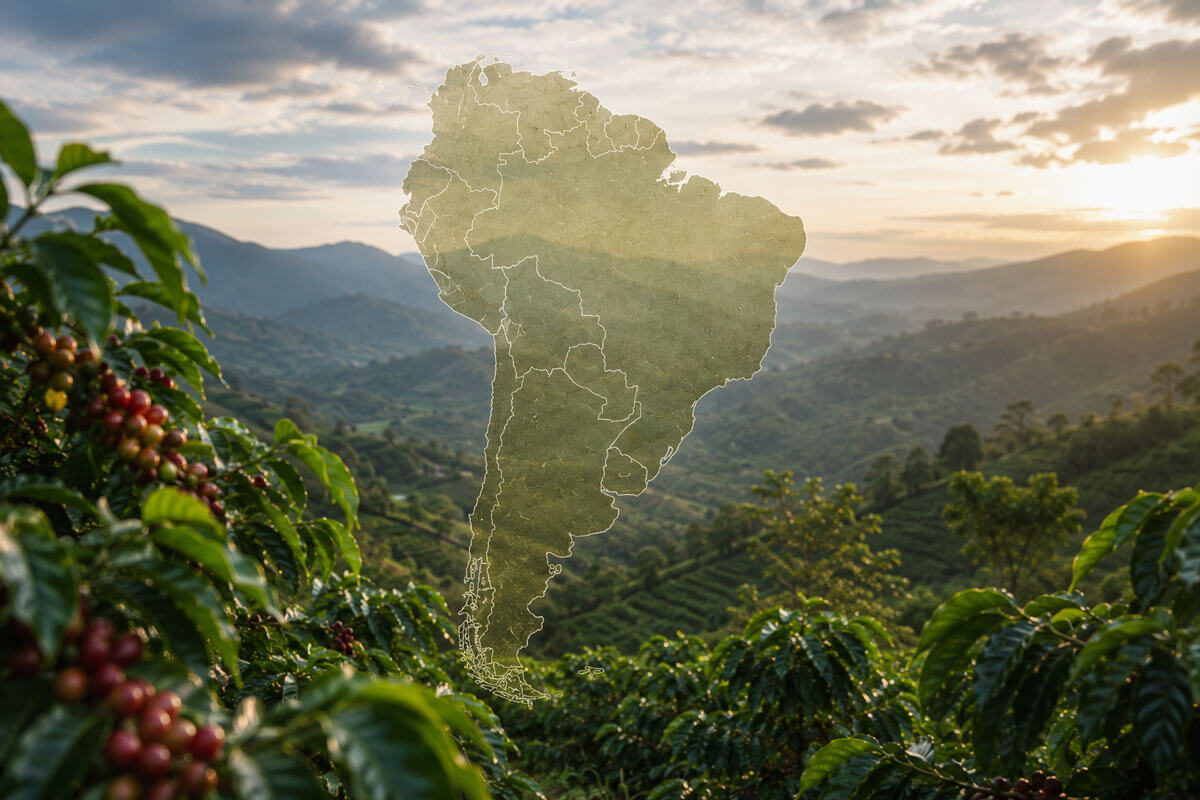
When people think about the world’s biggest coffee-producing countries, one continent immediately comes to mind: South America. This region has shaped the global coffee trade for more than a century, and it remains the single most important source of the coffee that fills cups around the world every morning. From the vast plantations of Brazil to the misty Andean slopes of Colombia and Peru, South America’s coffee-producing countries supply a remarkable share of global demand — and the statistics behind this dominance are genuinely striking.
In this article, we’ll break down the most important coffee-producing countries in South America, look at the latest production and export figures, and explain why this region continues to set the pace for the entire global coffee industry.
Why South America Leads the World’s Coffee-Producing Countries
South America’s dominance isn’t an accident of geography — it’s the result of a near-perfect combination of climate, altitude, and soil. The continent sits directly within, or close to, the so-called “Coffee Belt,” the tropical band between the Tropic of Cancer and the Tropic of Capricorn where coffee plants thrive. Volcanic soil, high altitudes, and consistent rainfall across Brazil, Colombia, Peru, Ecuador, and Bolivia create ideal growing conditions for coffee, particularly for the arabica variety, which is far more sensitive to climate than its hardier cousin, robusta.
Unlike Vietnam or Indonesia, where robusta dominates, most South American coffee-producing countries specialize almost entirely in arabica beans. This is a defining characteristic of the region: while robusta accounts for roughly 43% of global coffee output today, South America’s contribution to the world’s arabica supply is disproportionately large. According to industry estimates, Latin America as a whole — including Central America — produces more than half the world’s coffee and around 80% of all arabica coffee grown globally.
Global coffee production for the 2025/26 crop year is forecast at a record 178.8 million 60-kilogram bags, and South America’s coffee-producing countries account for a substantial portion of that total. Let’s look at each major producer individually.
Brazil: The World’s Undisputed Coffee Giant
No conversation about coffee-producing countries in South America — or anywhere else — can start anywhere but Brazil. Brazil has held the title of the world’s largest coffee producer for close to 150 years, and it isn’t close to relinquishing that position.
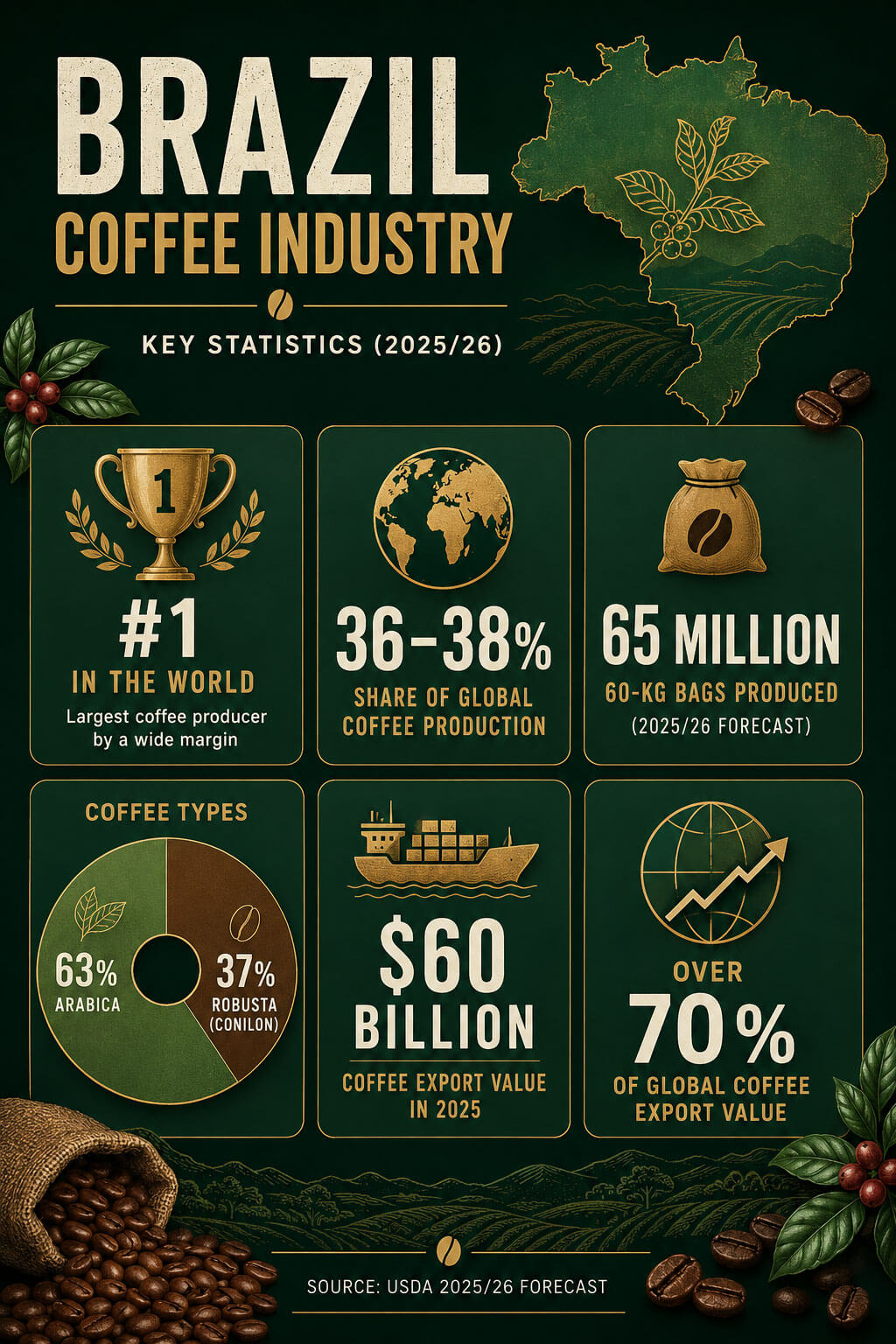
Key statistics for Brazil:
- World ranking: 1st (by a wide margin)
- World market share: approximately 36–38% of total global coffee production
- Total production (2025/26 forecast): around 65 million 60-kg bags, according to USDA figures
- Coffee type split: roughly 63% arabica, 37% robusta/conilon
- Export value: Brazil’s coffee exports generated nearly $60 billion in total trade value in 2025, representing over 70% of global coffee export value
Brazil’s scale is almost hard to comprehend. The country produces more coffee than Vietnam, Colombia, Indonesia, and Ethiopia combined. Its main growing regions — Minas Gerais, São Paulo, and Paraná — benefit from a mix of altitude, temperature, and soil conditions that support both arabica and robusta cultivation at an industrial scale. The dominant varietals include Mundo Novo, Catuaí, Bourbon, and Typica.
Interestingly, Brazil’s global share has actually declined significantly since the early 20th century, when the country supplied around 80% of the entire world’s coffee. As production expanded in Vietnam, Colombia, and parts of Africa and Asia throughout the 20th and 21st centuries, Brazil’s relative share fell — even though its absolute production volume kept growing. This is one of the more counterintuitive statistics in the global coffee trade: Brazil produces far more coffee today than it did a century ago, yet its percentage of world output is lower simply because so many other coffee-producing countries have entered the market.
Brazil’s production is also famous for its biennial cycle — a pattern in which a high-yield year is typically followed by a lower-yield year, driven by the natural growth cycle of the arabica plant. This cyclicality, combined with weather events like droughts and frosts, makes Brazil the single biggest swing factor in global coffee prices. When Brazilian harvests are disrupted, prices across the entire industry tend to spike, since no other coffee-producing country can quickly fill the resulting supply gap.
Colombia: The Home of Pure Arabica
If Brazil is the volume leader among coffee-producing countries in South America, Colombia is the quality benchmark. Colombia is one of the very few major coffee-producing countries in the world that grows 100% arabica coffee — no robusta is cultivated commercially within its borders.
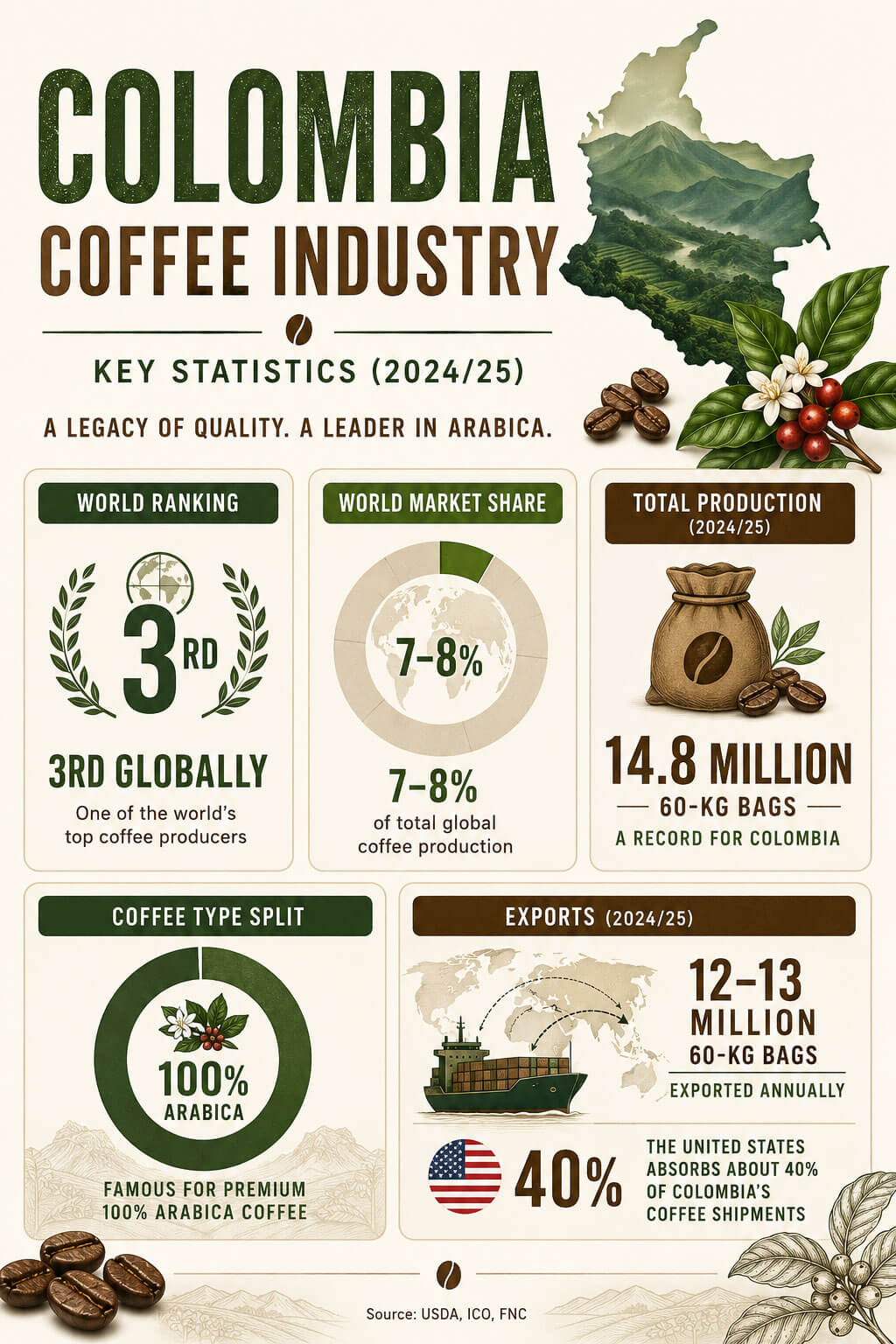
Key statistics for Colombia:
- World ranking: 3rd globally
- World market share: approximately 7–8% of total global production
- Total production (2024/25): around 14.8 million 60-kg bags — a record for the country
- Coffee type split: 100% arabica
- Exports: roughly 12–13 million bags annually, with the United States absorbing about 40% of shipments
Colombia’s coffee sector is built around smallholder farming. More than 550,000 families cultivate coffee across roughly 837,000 hectares, and the vast majority of these farms are smaller than five hectares. This decentralized structure is part of what gives Colombian coffee its reputation for meticulous, quality-focused production rather than industrial-scale volume.
One especially notable statistic: 87% of Colombia’s coffee-growing areas are now planted with rust-resistant varieties, up from just 25% in 2010. This shift reflects years of investment by Colombia’s national coffee federation, Fedecafé, in breeding programs designed to protect yields against coffee leaf rust — a fungal disease that has devastated harvests across Latin America in the past.
Domestic consumption in Colombia remains relatively modest for a major coffee-producing country, at roughly 2.3 million bags per year, meaning the vast majority of Colombian coffee is grown specifically for export markets.
Peru: South America’s Organic Coffee Leader
Peru doesn’t produce coffee at anywhere near the scale of Brazil or Colombia, but it holds a unique and increasingly important position among coffee-producing countries: it is one of the world’s leading exporters of certified organic and Fair Trade arabica coffee.
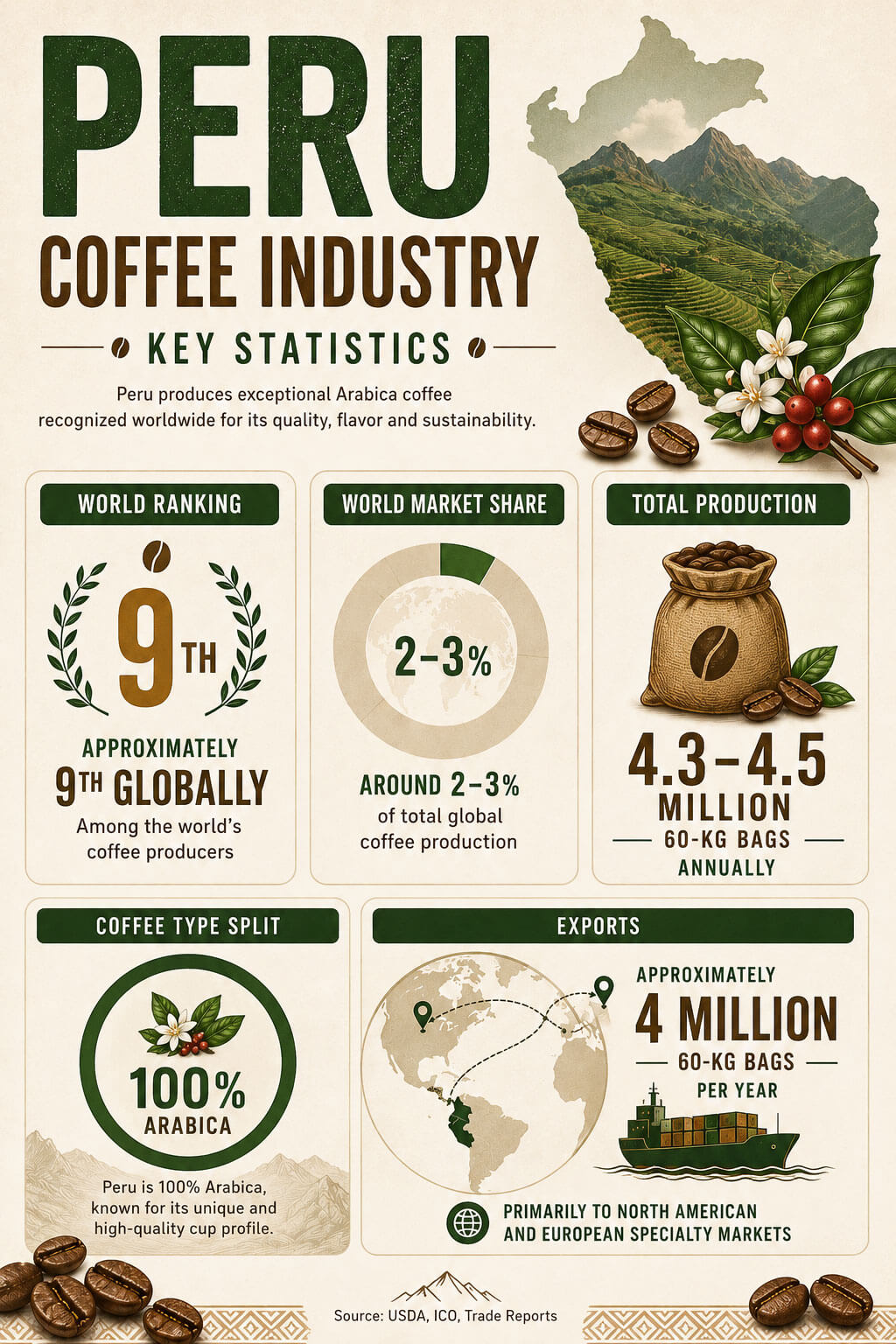
Key statistics for Peru:
- World ranking: approximately 9th globally
- World market share: around 2–3%
- Total production: roughly 4.3–4.5 million 60-kg bags annually
- Coffee type split: 100% arabica
- Exports: approximately 4 million bags per year, primarily to North American and European specialty markets
Peru’s main coffee-growing regions include Junín, San Martín, Cajamarca, and Amazonas, where coffee is typically grown on small, shade-covered farms at elevations above 1,600 meters. The dominant varietals — Typica, Caturra, Bourbon, and Catimor — are hand-picked between May and September and processed using washed or honey methods.
What makes Peru particularly interesting among South American coffee-producing countries is its strong organic identity. A large share of Peruvian coffee farms operate without synthetic fertilizers or pesticides, either by tradition or by design, which has allowed the country to position itself as a premium source for organic and specialty roasters worldwide. Peru is frequently cited as South America’s third-largest organic coffee producer, behind only Brazil and Colombia in overall regional output but ahead of nearly everyone in the organic segment specifically.
Domestically, Peruvians consume a comparatively large share of what they grow — historical estimates suggest local consumption absorbs around 40% of national production, a much higher domestic-use ratio than in Brazil or Colombia.
Ecuador: A Small but Distinctive Producer
Ecuador is a much smaller player among South America’s coffee-producing countries, but it holds a distinctive position because it grows both arabica and robusta — unlike arabica-only Colombia and Peru.
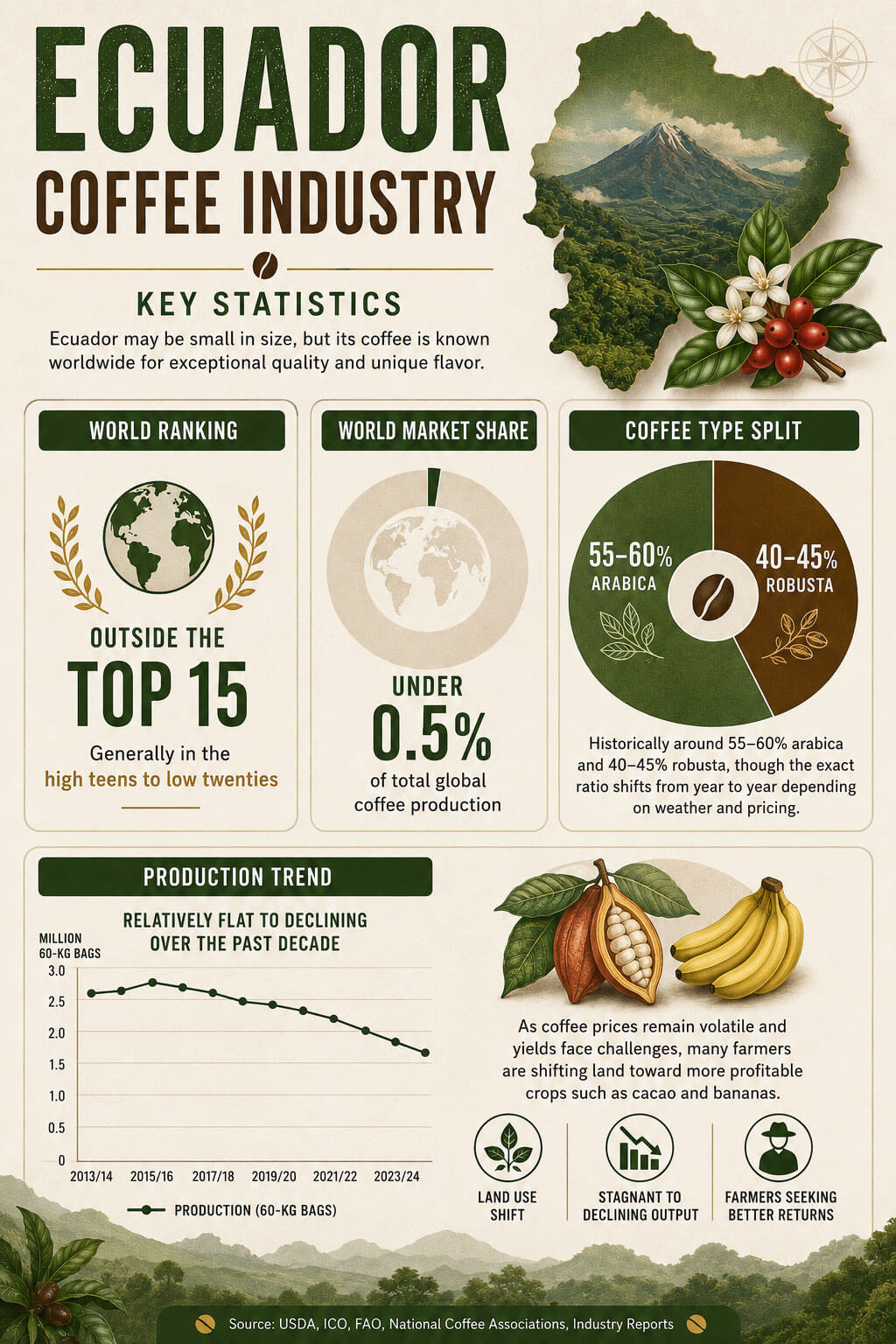
Key statistics for Ecuador:
- World ranking: outside the top 15, generally in the high teens to low twenties
- World market share: under 0.5%
- Coffee type split: historically around 55–60% arabica, 40–45% robusta, though the exact ratio shifts from year to year depending on weather and pricing
- Production trend: relatively flat to declining over the past decade, as farmers shift land toward other crops such as cacao and bananas
Ecuador’s coffee sector has struggled with competitiveness in recent years, as many smallholders have found other crops more profitable. Even so, Ecuador remains a notable name among coffee-producing countries because of its dual-variety production model, giving it more flexibility to respond to shifts in global demand between arabica and robusta markets. Ecuador’s coffee is also a regular presence in Colombia’s import mix, alongside Peru and Brazil, since Colombia occasionally imports lower-cost coffee to supplement its domestic supply.
Bolivia: A Micro-Producer with a Loyal Domestic Market
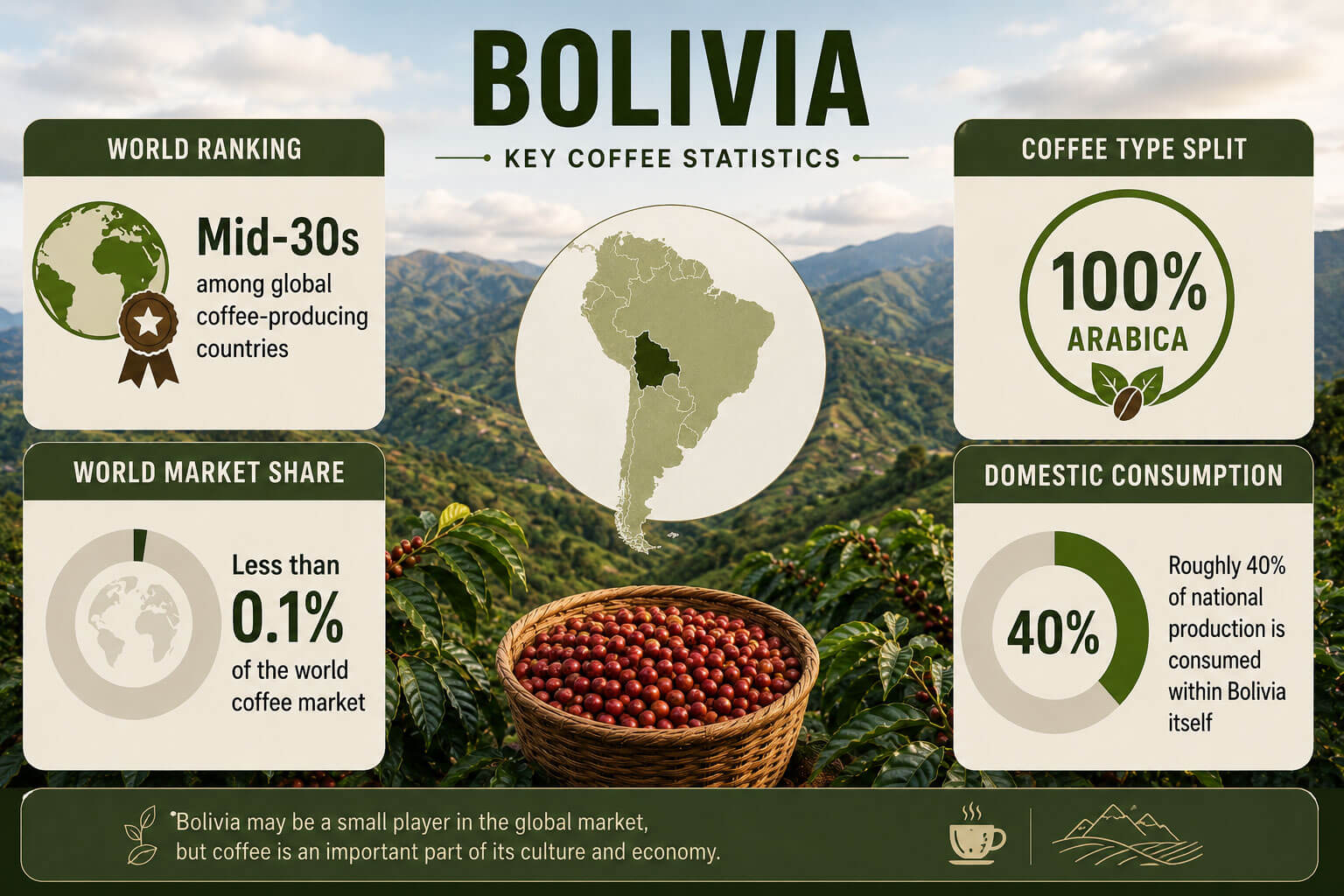
Bolivia represents the smallest of the significant coffee-producing countries covered in this overview, contributing well under 0.1% of global production. Despite its minimal footprint on the world stage, Bolivia’s coffee sector remains meaningful at home.
Key statistics for Bolivia:
- World ranking: mid-30s among global coffee-producing countries
- World market share: less than 0.1%
- Coffee type split: 100% arabica
- Domestic consumption: roughly 40% of national production is consumed within Bolivia itself
Bolivian coffee is grown primarily in the Yungas region of La Paz, at high altitudes that produce a distinctive, delicately sweet cup. Production has faced chronic challenges, including limited infrastructure, migration away from farming communities, and competition from coca cultivation, which is often more profitable for smallholders in the same growing regions. Even so, Bolivia continues to maintain a small but committed specialty coffee export segment, and its coffee occasionally appears in micro-lot and single-origin offerings from specialty roasters abroad.
Venezuela: A Once-Major Producer in Decline
Venezuela deserves a brief mention among South America’s coffee-producing countries, if only because of how far its industry has fallen. This country was once a significant regional exporter, but decades of economic instability have pushed the country from net exporter to net importer of coffee — a remarkable reversal for a nation with a long coffee-growing history in its Andean regions. Venezuela’s current global market share is negligible, and it is rarely included in top-producer rankings today, but its trajectory is a useful reminder that a country’s position among the world’s coffee-producing countries can change dramatically over time.
Arabica vs. Robusta: The Defining Split in South America
One of the most useful ways to understand coffee-producing countries in South America is through the lens of arabica versus robusta production.
- Colombia, Peru, and Bolivia: essentially 100% arabica
- Brazil: a mixed producer, with arabica typically making up 60–70% of output and robusta/conilon the remainder
- Ecuador: the region’s most balanced dual-variety producer, with meaningful volumes of both types
This split matters enormously for global pricing and quality segmentation. Arabica, prized for its smoother, more aromatic profile, commands significantly higher prices and dominates the specialty coffee segment. Robusta, with its higher caffeine content and more bitter profile, is used mainly in instant coffee and commercial blends. Because South America’s coffee-producing countries lean so heavily toward arabica, the region has an outsized influence on specialty and premium coffee markets specifically — even in categories where its overall volume share is smaller than Asia’s.
Climate Change and the Future of South American Coffee
No modern discussion of coffee-producing countries would be complete without acknowledging the growing impact of climate volatility. In recent years, prolonged droughts and record-high temperatures have repeatedly disrupted harvests in Brazil, while irregular rainfall patterns have affected yields in Colombia, Peru, and Ecuador alike.
These disruptions have contributed to historically elevated coffee prices. Arabica prices have more than doubled since the start of 2024, and the ICO’s composite price index has nearly tripled over the past several years, driven by tightening global stocks and repeated weather-related supply shocks in South America’s largest producing nations. Analysts broadly expect prices to remain volatile in the near term, even as production recovers in some regions.
For farmers across South America’s coffee belt, this has accelerated investment in climate-resilient varietals, expanded irrigation, and agroforestry techniques designed to stabilize yields. Colombia’s rapid adoption of rust-resistant coffee trees is one clear example of this broader regional shift toward climate adaptation.
Conclusion
South America remains the beating heart of the global coffee industry, and its coffee-producing countries — led overwhelmingly by Brazil, followed by Colombia, Peru, Ecuador, and Bolivia — continue to shape everything from daily prices to long-term specialty coffee trends. Brazil alone accounts for well over a third of the world’s total coffee supply, while Colombia and Peru have carved out reputations for quality and organic production that punch well above their production volumes. Even the smaller players, like Ecuador and Bolivia, add distinct character to a region that, taken together, supplies a majority of the coffee the world drinks every single day.
As climate pressures continue to reshape agricultural output worldwide, South America’s coffee-producing countries will likely remain both the most important — and the most closely watched — part of the global coffee supply chain for decades to come.