

The Perfect Coffee Morning Routine for Working From Home
If you work from home, you already know the strange trap that comes with it: no commute, no dress code, and yet somehow the mornings can feel messier than they ever did in an office. Without the natural structure of a drive, a train, or a walk to the building, it’s easy to roll out of bed, open a laptop, and start your day already scattered. That’s exactly why a solid coffee morning routine matters so much for anyone doing remote work.
This article is for everyone building a life around a home office — whether you’re single and setting your own pace, or juggling kids, partners, and a dozen interruptions before 9 a.m. A thoughtful morning routine isn’t about becoming a productivity robot. It’s about giving your brain and body a signal that says: the workday is starting now, and I’m ready for it. Coffee, it turns out, is one of the most powerful (and enjoyable) tools for building that signal.
Below, you’ll find a complete, practical guide to designing a coffee morning routine for working from home — one that boosts focus, protects your energy, and actually feels good to repeat every single day.
Why Your Morning Routine Matters More When You Work From Home
When you commute to an office, your morning has built-in transitions. You wake up, get dressed, travel, and arrive somewhere that is only for work. That physical and mental shift helps your brain switch from “home mode” to “work mode.”
Working from home removes that natural boundary, which means you have to create it yourself. Without a morning routine, it’s common to fall into one of two traps:
- Rolling out of bed and straight into your inbox, still half-asleep, answering emails before you’ve even had a moment to think clearly.
- Drifting through the morning aimlessly, checking your phone, making breakfast, doing a load of laundry, and suddenly it’s 10:30 and you haven’t started real work.
A structured coffee morning routine solves both problems. It gives your day a clear starting line, a moment of calm before the chaos, and a mental cue that tells your brain: it’s time to focus.
Research on habit formation consistently shows that consistent morning rituals reduce decision fatigue — the mental exhaustion that comes from making too many small choices early in the day. When your morning is a routine rather than a series of decisions, you save your best mental energy for the work that actually matters.

Why Coffee Is the Perfect Anchor for a Remote Work Morning
Coffee isn’t just about the caffeine (though that certainly helps). It’s about ritual. The process of grinding beans, brewing, pouring, and sitting with that first cup creates a natural pause — a few minutes that belong entirely to you before the demands of remote work take over.
Here’s why coffee works so well as the centerpiece of a home office morning:
- It’s a built-in timer. A cup of coffee takes roughly 10–20 minutes to prepare and enjoy, giving you a natural buffer between waking up and logging on.
- It signals a transition. The smell, the warmth, and the taste are strong sensory cues that tell your brain a new phase of the day has begun.
- It’s something to look forward to. Unlike checking email, making coffee is genuinely pleasant, which makes the whole morning feel less like a grind and more like a small daily reward.
- It pairs naturally with mindfulness. Many remote workers use their coffee time to journal, stretch, or simply sit quietly — habits that are much harder to fit in once the workday officially starts.
If you’re serious about building this ritual, investing in a reliable home setup makes a real difference. A good drip coffee maker or a compact espresso machine for home use can turn a rushed cup of instant coffee into a genuine morning ritual worth waking up for.
Building Your Coffee Morning Routine: Step by Step
Let’s break down a realistic, sustainable coffee morning routine designed specifically for people doing remote work. You don’t need to follow every step exactly — the goal is to find a rhythm that fits your life, whether you’re single, partnered, or managing a full household.
1. Wake Up at a Consistent Time
Your body thrives on rhythm. Waking up at roughly the same time every day — yes, even on weekends — helps regulate your internal clock, making it easier to fall asleep and wake up naturally. A consistent wake-up time is the foundation of any effective morning routine, coffee-based or otherwise.
If you struggle with consistency, consider a sunrise alarm clock, which gradually brightens your room to mimic natural sunlight and makes waking up far less jarring than a blaring phone alarm.
2. Avoid Your Phone for the First 15–20 Minutes
This one is hard, but it’s a game-changer. Reaching for your phone the moment you open your eyes floods your brain with notifications, news, and other people’s priorities before you’ve even had a chance to set your own. Protecting the first few minutes of your day from screens gives your mind space to wake up calmly instead of reactively.
3. Hydrate Before You Caffeinate
After 6–8 hours of sleep, your body is naturally dehydrated. A glass of water before your coffee helps kickstart your metabolism and can actually make your coffee taste better and hit you more smoothly, without the jittery crash that comes from caffeinating on an empty, dehydrated system.
4. Make Your Coffee — Mindfully
This is the heart of the routine. Instead of gulping coffee while scrolling through Slack, treat your coffee-making process as a few minutes of intentional calm. Grind your beans, watch the water heat, listen to the sounds of brewing. If you have a moment, step outside or sit by a window while it brews.
For those who want to elevate this ritual, a few tools can make a noticeable difference:
- A burr coffee grinder for fresher, more consistent grounds
- A pour-over coffee dripper set for a slower, more mindful brewing process
- An insulated travel mug that keeps your coffee hot as you move between rooms during a busy household morning
5. Sit With Your Coffee — Without Working
Here’s the part most remote workers skip, and it’s the most important one: actually sit down and enjoy your coffee before opening your laptop. Even five to ten minutes of quiet time — reading, journaling, stretching, or simply looking out the window — helps you start the day from a place of calm rather than urgency.
If mornings in your house are chaotic (hello, parents of young kids), this might mean drinking your coffee in short sips between tasks rather than one long, peaceful sitting. That’s okay. The goal isn’t perfection — it’s carving out some intentional space before diving into work.
6. Move Your Body
You don’t need an intense workout. Even five minutes of stretching, a short walk around the block, or a few yoga poses can wake up your body and clear mental fog. Since working from home eliminates the physical movement of a commute, deliberately building movement into your morning is especially important for both energy and long-term health.
7. Get Dressed for the Day
It might sound trivial, but changing out of pajamas — even into casual clothes — creates a psychological shift that tells your brain “the workday has started.” Getting dressed is a small but powerful cue that separates home-relaxation mode from home-work mode.
8. Set Up Your Workspace
Before you officially clock in, take two minutes to prepare your home office. Clear your desk, open the apps or documents you’ll need first, and make sure your coffee is within reach. A clean, organized desk setup reduces friction and helps you start work with focus instead of clutter-induced stress.
If your current setup isn’t cutting it, a few upgrades can meaningfully boost comfort and focus throughout the day:
- An ergonomic office chair to support long stretches of desk work
- A standing desk converter to add movement and variety to your workday
- A desk organizer set to keep your workspace tidy and distraction-free
9. Plan Your Day With Time Blocking
Before diving into your inbox, take five minutes to outline your day using time blocking — assigning specific chunks of time to specific tasks rather than working from a vague to-do list. For example:
- 9:00–10:30: Deep work on your most important project
- 10:30–10:45: Coffee break and quick stretch
- 10:45–12:00: Meetings and emails
- 12:00–1:00: Lunch
- 1:00–3:00: Focused project work
- 3:00–3:15: Second coffee or tea break
- 3:15–5:00: Wrap-up tasks and planning for tomorrow
Time blocking turns a chaotic to-do list into a realistic, structured plan, and it pairs beautifully with your coffee ritual — your morning cup can mark the start of your first work block, and a second coffee break in the early afternoon gives you a natural pause to reset.
10. Start Work With Intention
Finally, start work on your most important task first — not your inbox. Checking email first thing means your morning gets hijacked by other people’s priorities. Instead, use the focus and calm you’ve built through your coffee routine to tackle the task that matters most, before the day’s inevitable distractions arrive.

Coffee Break Strategies That Keep You Productive All Day
Your morning coffee is just the beginning. A well-timed coffee break later in the day can prevent the mid-afternoon slump that hits so many remote workers.
A few tips for making the most of your breaks:
- Step away from your desk entirely. Even a five-minute break in a different room (or outside) helps your brain reset.
- Avoid screens during your break. Scrolling social media during a coffee break isn’t really resting — it’s just a different kind of stimulation.
- Time it strategically. Many people find a second coffee around 1:30–2:30 p.m. helps bridge the natural post-lunch energy dip without interfering with nighttime sleep.
- Pair it with movement. A short walk with your coffee in hand can boost both energy and creativity.
Adapting Your Routine for Family Life
If you’re working from home with kids, partners, or a busy household, a rigid routine can quickly fall apart — and that’s completely normal. Instead of aiming for a perfect, uninterrupted ritual, focus on protecting a few non-negotiable minutes, even if they’re scattered throughout a chaotic morning.
Some practical adjustments:
- Prep the night before. Set your coffee maker on a timer or pre-measure your grounds so your morning coffee is ready with zero extra effort.
- Use a shared family calendar to coordinate school drop-offs, meetings, and quiet work blocks, so everyone in the house knows when “focus time” is happening.
- Communicate your work start time to your family, even informally, so there’s a shared understanding of when the household transitions from morning chaos to work mode.
- Give yourself grace. Some mornings, your “routine” might just be a rushed coffee in a travel mug on your way to your desk — and that’s still better than skipping the ritual altogether.
Download Your Free Morning Routine Checklist
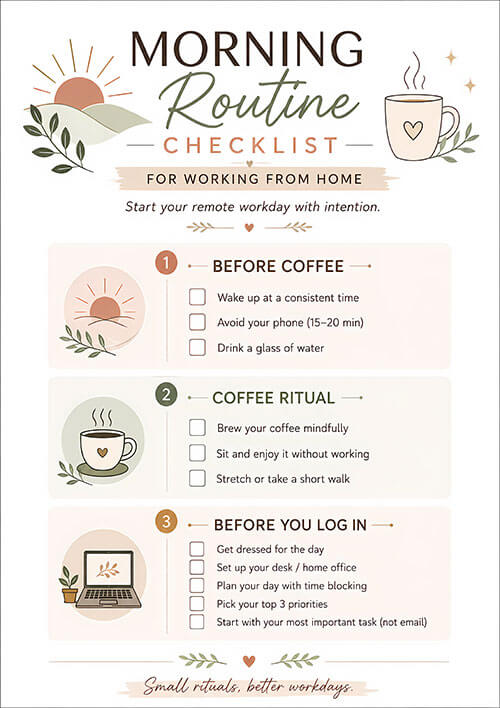
Turn your coffee into the start of a calmer, more productive workday.
Keep this beautiful printable next to your coffee maker or workspace and follow the same simple routine every morning—so you can start work feeling focused instead of overwhelmed.
What’s inside
✔ A printable Morning Routine Checklist
✔ A simple 3-step routine for working from home
✔ Easy daily habits you can follow in under 30 minutes
✔ Clean A4 design ready to print
Instant PNG download • Free • Print as many copies as you’d like
Common Mistakes to Avoid
Even with the best intentions, a few habits can quietly sabotage your coffee morning routine:
- Checking email before coffee. This immediately shifts you into reactive mode instead of intentional mode.
- Skipping breakfast entirely. Coffee on a completely empty stomach can lead to jitters and an energy crash later in the morning.
- Overloading on caffeine. More coffee doesn’t always mean more focus — too much can increase anxiety and disrupt sleep later that night.
- Treating the routine as all-or-nothing. Missing one step doesn’t mean the whole morning is ruined. Consistency over time matters far more than perfection on any single day.
Final Thoughts
A thoughtful coffee morning routine is one of the simplest, most enjoyable ways to bring structure and calm to working from home. It doesn’t require expensive equipment or a rigid schedule — just a few intentional minutes each morning to hydrate, brew, breathe, and set your intentions before diving into work.
Whether you live alone and savor a slow, quiet cup of coffee, or you’re sipping yours between school drop-offs and morning meetings, the goal is the same: create a small, repeatable ritual that tells your brain the workday has begun — on your terms, in your own home office, without a commute in sight.
Start small. Pick two or three elements from this guide — maybe hydrating before coffee, sitting quietly for five minutes, and time blocking your first work task — and build from there. Over time, these small habits compound into a morning routine that doesn’t just prepare you for work, but genuinely makes your days better.