The Spaceballs Coffee Scene: How Mr. Coffee Became One of the Funniest Gags in Movie History
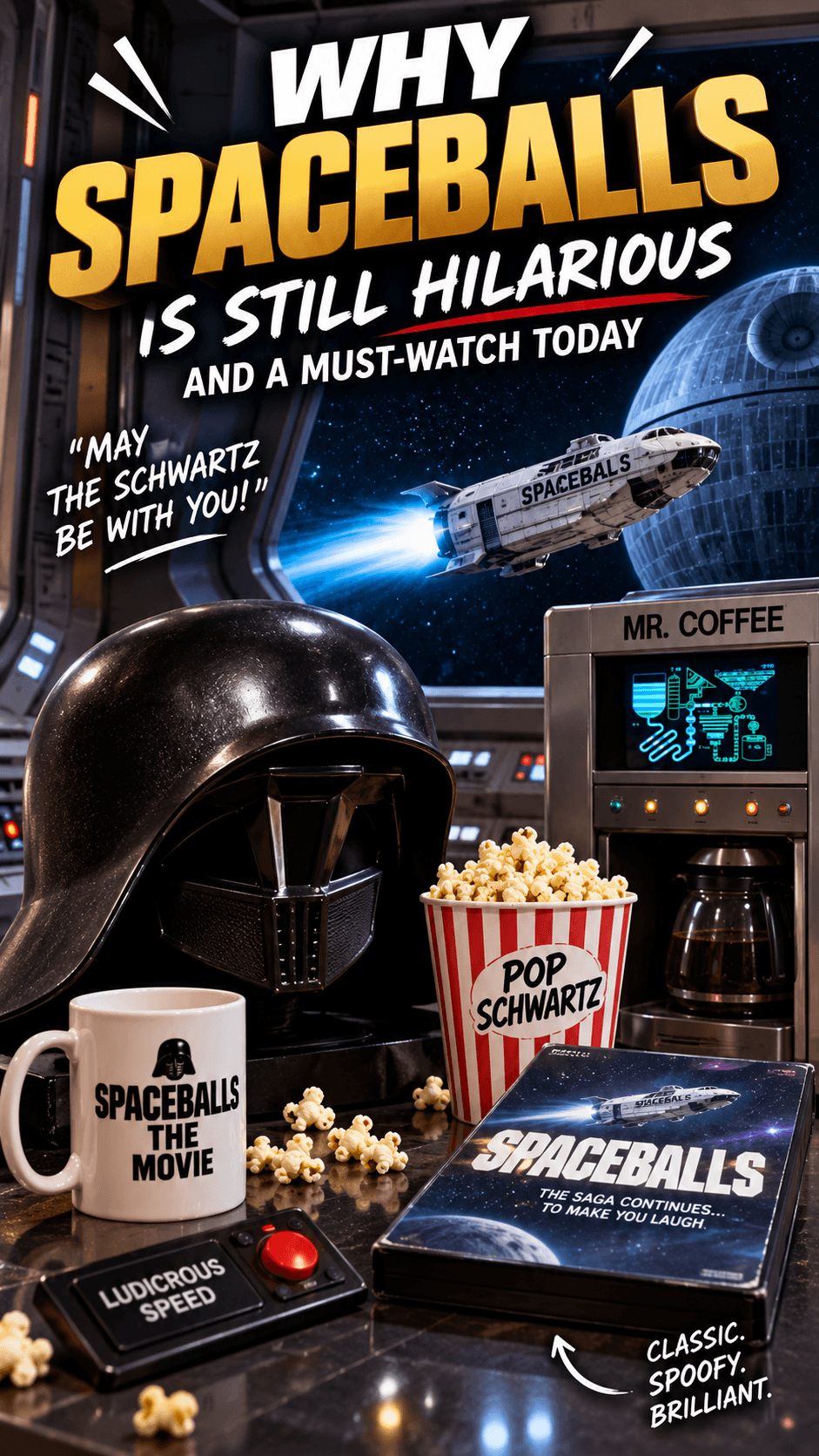
When people talk about the greatest movie parodies of all time, the conversation almost always lands on Spaceballs, Mel Brooks’ 1987 send-up of Star Wars and the wider science-fiction genre. Packed with sight gags, dad-joke puns, and quotable one-liners, the film has earned a permanent spot in comedy history. But among all its absurd moments, one small scene keeps resurfacing on social media, in “best of” compilations, and in casual conversations between fans decades later: the now-legendary coffee scene featuring a gadget the crew nicknamed Mr. Coffee.
In this article, we’ll look at what makes Spaceballs such an enduring movie, break down exactly what happens in the coffee scene, and explain why a joke about a coffee maker has managed to outlive plenty of “serious” sci-fi moments from the same era. We’ve also included the original clip below so you can watch the Mr. Coffee gag for yourself.
What Is Spaceballs, Exactly?
Spaceballs is a 1987 American science-fiction comedy directed by Mel Brooks, who also co-wrote the screenplay and starred in a dual role as President Skroob and the wise little guru Yogurt. The movie was released by Metro-Goldwyn-Mayer on June 24, 1987, and it stars Bill Pullman as the roguish mercenary Lone Starr, John Candy as his loyal half-man, half-dog sidekick Barf, and Daphne Zuniga as the runaway Princess Vespa of the planet Druidia.
The premise is a direct, gleeful parody of Star Wars: the villainous Spaceballs, led by the bumbling President Skroob, have used up their own planet’s air supply and plan to steal the atmosphere of Druidia. Standing in their way are Lone Starr, Barf, Vespa, and her sarcastic droid Dot Matrix. Along the way, they run into Yogurt, who teaches Lone Starr about a mystical force called “the Schwartz” — a none-too-subtle riff on the Force from Star Wars.
Spaceballs doesn’t limit its jokes to just one franchise, either. Fans have long pointed out nods to Star Trek, Alien, Planet of the Apes, and 2001: A Space Odyssey scattered throughout the runtime. The movie also features the delightfully incompetent villain duo of Dark Helmet, played by Rick Moranis, and Colonel Sandurz, played by George Wyner — the two characters at the center of the coffee scene we’re about to break down.
When it first hit theaters, Spaceballs received mixed reviews from critics, many of whom felt the parody didn’t quite reach the heights of Brooks’ earlier work like Blazing Saddles or Young Frankenstein. But home video and cable reruns did what theatrical release couldn’t: they turned Spaceballs into a genuine cult classic, beloved by generations who quote its jokes long after the original Star Wars trilogy references have faded from casual pop culture.
Setting the Scene: Where the Coffee Joke Happens
The coffee scene takes place aboard Spaceball One, the villains’ enormous, city-sized spacecraft known as “the Winnebago.” Dark Helmet, the Darth Vader stand-in with a comically oversized helmet, is trying to track down Princess Vespa so he can use her as leverage against Druidia. He turns to Colonel Sandurz for an update, asking whether they have visual contact with their target yet.
Sandurz explains that while they don’t have a visual, they do have something showing up on the radar screen. Dark Helmet, never one to delegate, decides he wants to look at the radar himself instead of having Sandurz “punch it up” for him. That decision is where the joke kicks in.
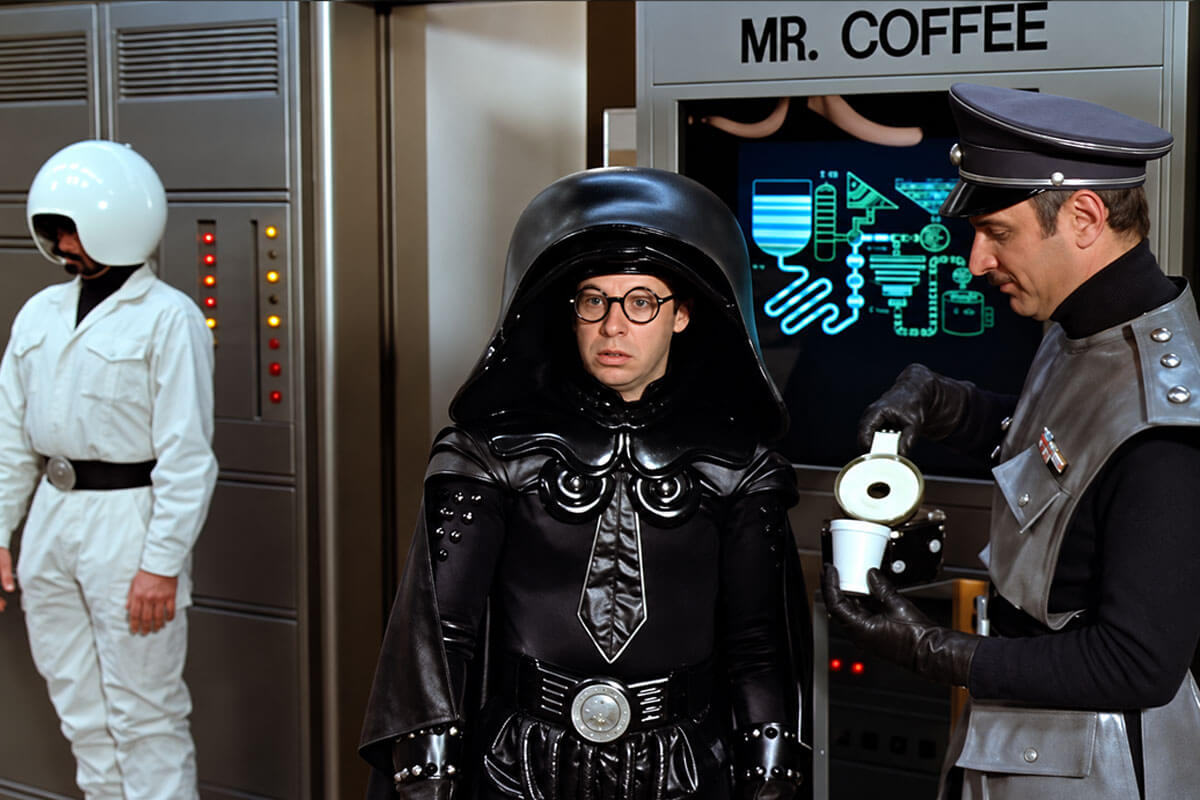
When Dark Helmet marches over to look at the radar screen, he’s baffled by what he sees: a strange device that’s churning, bubbling, and gurgling instead of showing any kind of tactical display. Confused and annoyed, he demands to know what kind of radar screen produces that sort of noise. Sandurz calmly informs him that what he’s actually looking at isn’t the radar at all — it’s the ship’s coffee machine, affectionately nicknamed Mr. Coffee, sitting right next to the actual radar unit, which is labeled “Mr. Radar.”
The Mr. Coffee Punchline
This is where Spaceballs delivers one of its sharpest, most quietly brilliant jokes. Rather than admitting he made a mistake, Dark Helmet instantly pivots and pretends he knew all along that he was looking at the coffee maker. He claims he always has coffee while watching radar, and Sandurz — ever the loyal, slightly terrified subordinate — immediately backs him up, insisting that “everybody knows that.” The ship’s crewmen, standing nearby, nervously agree as well, too intimidated to contradict their commander.
The joke lands on multiple levels at once. First, there’s the simple sight gag: a fully personified, over-designed coffee machine sitting next to an equally over-designed radar screen, the kind of visual absurdity Mel Brooks loved to slip into his sci-fi parody. Second, there’s the character comedy: Dark Helmet’s desperate need to save face rather than admit confusion is a perfect distillation of his blustering, insecure personality throughout the entire movie. And third, there’s the sheer randomness of naming a coffee machine “Mr. Coffee” — a knowing wink at the real-world brand of the same name, which by the 1980s had become one of the most recognizable home coffee maker brands in America.
After getting his cup of coffee, Dark Helmet takes a sip, finds it far too hot, and comically spits it back out — a small physical-comedy beat that caps off the exchange and reminds the audience that no matter how much power this villain wields, he’s still hopelessly out of his depth. Mr. Coffee even makes a return appearance later in the movie, when Dark Helmet pours himself another cup while fast-forwarding through a cassette copy of the film itself — one of Spaceballs‘ many self-referential jokes about its own existence as a movie.
Watch the Scene for Yourself
If you want to see the timing, the delivery, and Rick Moranis’ expressions for yourself, the full coffee scene clip is embedded below. It only runs a couple of minutes, but it’s a perfect snapshot of why Spaceballs has stayed so quotable for nearly forty years.
Why a Small Coffee Joke Became So Iconic
It’s worth asking why, out of all the elaborate parody sequences in Spaceballs — the “ludicrous speed” chase, the “Schwartz” lightsaber duel, the merchandising gag where Yogurt shows off Spaceballs action figures and lunch boxes — a brief exchange about a coffee machine has become one of the movie‘s most frequently shared clips online.
Part of the answer is relatability. Most viewers have never operated a spaceship radar system, but almost everyone understands the specific comedy of a boss who refuses to admit he doesn’t know what he’s looking at. The coffee scene works because it’s grounded in a very ordinary, very human dynamic: an authority figure bluffing his way through embarrassment while the people around him play along out of self-preservation. That’s a joke that translates whether you saw Spaceballs in theaters in 1987 or discovered it on a streaming service last month.
There’s also the fact that the joke is entirely visual and self-contained. You don’t need deep knowledge of Star Wars or the rest of the movie‘s plot to understand what’s funny about the coffee scene — the labels “Mr. Coffee” and “Mr. Radar” do most of the comedic heavy lifting on their own, which is exactly why the clip performs so well as a standalone piece of content on platforms designed for short attention spans.
Finally, there’s genuine brand recognition at play. Mr. Coffee is a real American coffee maker company, founded in the early 1970s in Cleveland, Ohio, and famously promoted by baseball legend Joe DiMaggio. By the time Spaceballs came out in 1987, “Mr. Coffee” was already a household name for millions of Americans, which made naming a piece of spaceship equipment after a familiar kitchen appliance an instantly recognizable, low-effort, high-reward joke — very much in keeping with Mel Brooks’ habit of blending high-concept parody with everyday, relatable references.
Spaceballs’ Legacy — and What Comes Next
Nearly four decades after its release, Spaceballs continues to find new audiences. Lines like “May the Schwartz be with you” and “Ludicrous speed, go!” remain staples of internet meme culture, and the coffee scene in particular keeps circulating as a bite-sized clip perfectly suited for social sharing.
That staying power is part of why a long-rumored sequel finally has a release date. Spaceballs: The New One, from Amazon MGM Studios, is scheduled to arrive in theaters on April 23, 2027 — timed to coincide with the original movie‘s 40th anniversary. Reports indicate that several original cast members, including Bill Pullman, Rick Moranis, Daphne Zuniga, and George Wyner, are set to return alongside Mel Brooks, joined by newer stars like Keke Palmer and Lewis Pullman. Josh Greenbaum is directing from a script co-written by Josh Gad, which suggests the follow-up will keep the same spirit of loving, self-aware parody that made the first movie so quotable — coffee jokes and all.
Final Thoughts
Spaceballs endures not because every joke is a home run, but because Mel Brooks understood that comedy works best when it’s layered — big parody concepts sitting right alongside small, human moments of embarrassment and bluster. The coffee scene is the perfect example: a throwaway gag about a spaceship’s radar screen turning out to be a coffee maker, elevated by a villain who would rather lie to his own crew than admit confusion.
Whether you’re rewatching Spaceballs for the tenth time or discovering it for the first time through a viral clip, the Mr. Coffee bit is a great reminder of why this movie has held up as a comedy classic. It’s silly, it’s specific, and — like a good cup of coffee — it never really gets old.