Coffee-Producing Countries in the Caribbean and Hawaii
Coffee is one of the most globally traded agricultural commodities, but the world’s supply is dominated by a small number of giants. Brazil and Vietnam alone account for well over half of all coffee grown on Earth. Against that backdrop, the coffee-producing countries of the Caribbean and the U.S. state of Hawaii look almost like rounding errors — combined, they represent a tiny sliver of global output. Yet these origins punch far above their weight in reputation, price, and cultural cachet.
This article breaks down the latest production statistics for the major Caribbean coffee-producing nations — Jamaica, the Dominican Republic, Haiti, Cuba, and Puerto Rico — alongside Hawaii, the only U.S. state that grows coffee commercially at scale. We’ll look at how much coffee each region produces, how their beans compare on the world market, and why these coffee-producing countries remain some of the most talked-about origins in the specialty coffee world despite their minuscule market share.
Why Small Coffee-Producing Countries Still Matter
Before diving into the numbers, it’s worth understanding why places that grow less than 1% of the world’s coffee combined still deserve attention. Scarcity and geography drive price, and both the Caribbean and Hawaii offer something Brazil’s flat plantations cannot: volcanic soil, high elevation, isolated microclimates, and — critically — legally protected origin names.
Jamaica Blue Mountain and Hawaii’s Kona coffee are both examples of geographic indication (GI) protected coffees, meaning only beans grown in narrowly defined regions can legally carry those names. That legal protection, combined with limited farmland, is why a pound of authentic Jamaica Blue Mountain or Kona coffee can retail for $30 to $70 per pound — five to ten times the price of a standard commercial-grade coffee. In short, these coffee-producing countries compete not on volume but on exclusivity.
Global Context: How Small Is “Small”?
According to data compiled by the International Coffee Organization (ICO) and the USDA Foreign Agricultural Service, global coffee production now exceeds 170 million 60-kilogram bags per year, with Brazil producing roughly 65 million bags and Vietnam around 29 million bags in a typical season. Against that scale, the entire Caribbean region and Hawaii combined still account for well under 1% of global coffee supply — a figure that has changed very little since the early 2010s, despite hurricanes, pests, and shifting labor markets reshaping individual harvests.
Below is a country-by-country breakdown of the region’s most important coffee-producing countries, with updated statistics reflecting recent harvest seasons.
Jamaica: Home of the World’s Most Famous Small-Batch Coffee
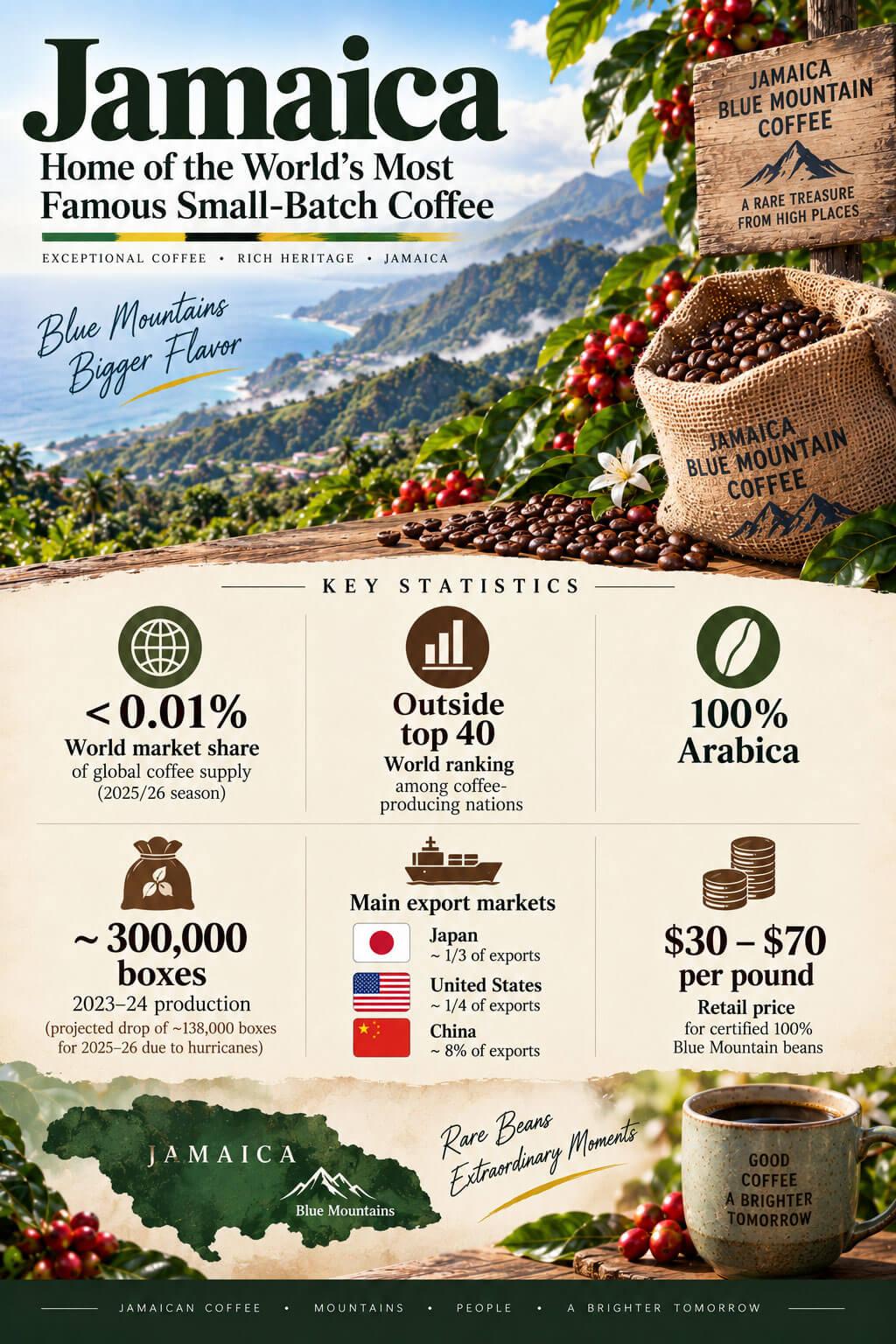
Jamaica remains the best-known Caribbean coffee producer, almost entirely because of one product: Jamaica Blue Mountain coffee, grown in a roughly 6,000-hectare protected zone in the Blue Mountains at elevations between 3,000 and 5,500 feet.
Key statistics:
- World market share: Less than 0.01% of global coffee supply as of the 2025/26 season
- World ranking: Outside the top 40 producing nations
- Coffee type: 100% Arabica
- 2023–24 production: Approximately 300,000 boxes of cherry coffee, though industry analysts projected a drop of roughly 138,000 boxes for the 2025–26 crop year following back-to-back hurricanes in 2024 and 2025
- Primary export markets: Japan (about one-third of exports), the United States (roughly one-quarter), and China (around 8%)
- Retail price: $30–$70 per pound for certified 100% Blue Mountain beans
What makes Jamaica’s story remarkable is the gap between its tiny output and its market visibility. Roughly 90% of certified Blue Mountain coffee is exported, and Japan alone has historically imported about 70% of the total crop — a relationship dating back decades of dedicated Japanese buyers securing supply contracts directly with Jamaican farms. Interestingly, Jamaica also imports a significant volume of lower-grade coffee (largely from the U.S., Mexico, and Colombia) to meet domestic demand, since nearly all of its premium output is earmarked for export.
Historically, Jamaica’s coffee legacy runs even deeper: between 1800 and 1840, Jamaica was briefly the largest coffee-producing country in the world, harvesting around 70,000 tons annually — a scale unimaginable today but a reminder that market position in coffee can shift dramatically over centuries.
Dominican Republic: The Caribbean’s Largest Coffee Producer by Volume
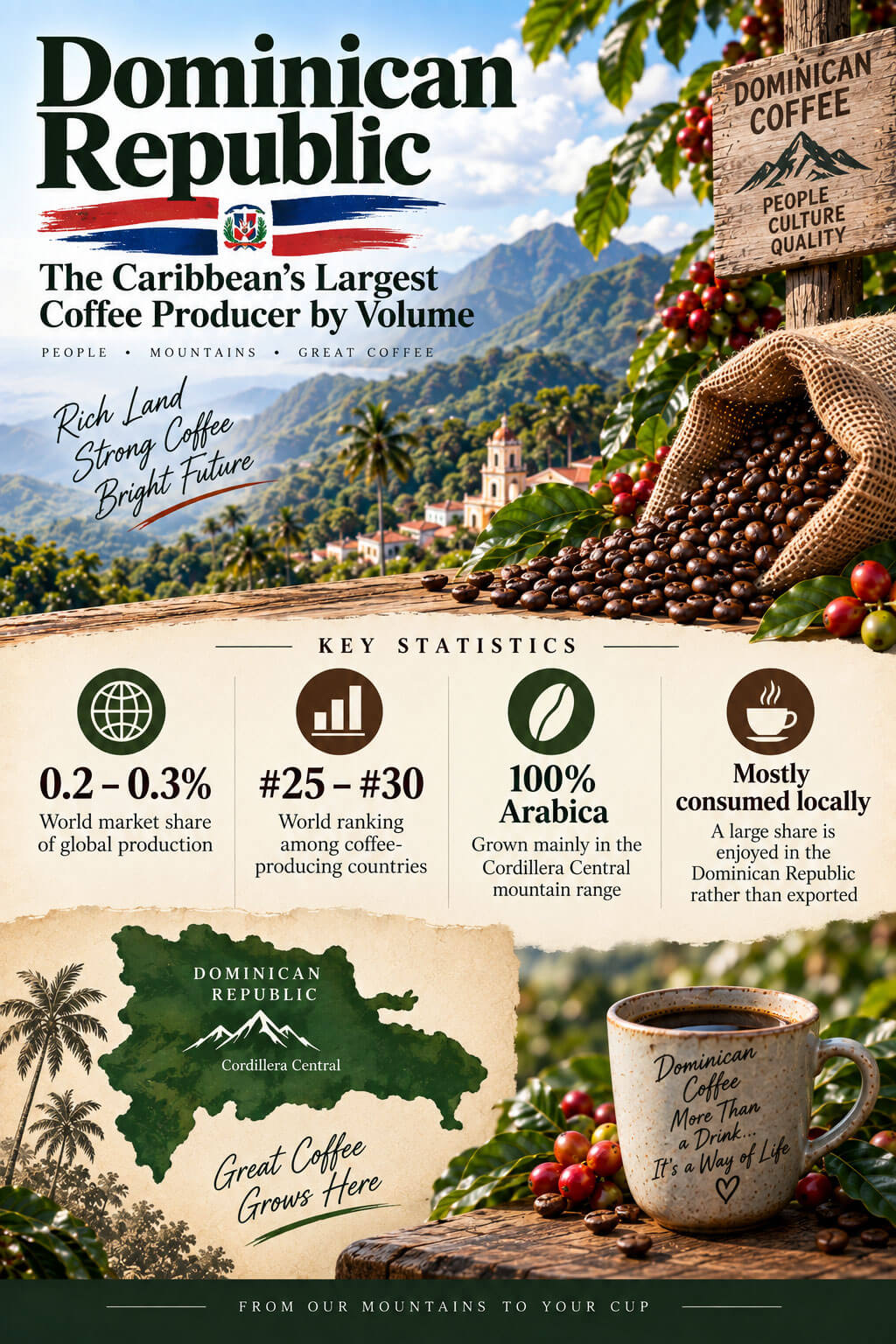
While Jamaica dominates headlines, the Dominican Republic is actually the largest coffee producer by volume among the Caribbean nations.
Key statistics:
- World market share: Approximately 0.2–0.3% of global production
- World ranking: Generally in the 25th–30th range among coffee-producing countries
- Coffee type: 100% Arabica, grown mainly in the Cordillera Central mountain range
- Domestic consumption: A large share of Dominican coffee is consumed locally rather than exported, unlike Jamaica’s export-heavy model
The Dominican Republic benefits from favorable mountain terrain and a well-established domestic coffee culture, meaning it doesn’t rely as heavily on a single premium export brand the way Jamaica does with Blue Mountain. Instead, its coffee industry serves both a strong internal market and a growing specialty export segment aimed at U.S. and European buyers seeking traceable, small-farm origins.
Haiti: A Historic Producer Rebuilding Its Coffee Industry
Haiti’s coffee history predates most of its Caribbean neighbors — in the 18th century, Haiti (then Saint-Domingue) was one of the world’s dominant coffee exporters, supplying a significant share of Europe’s coffee at the height of French colonial agriculture.
Key statistics:
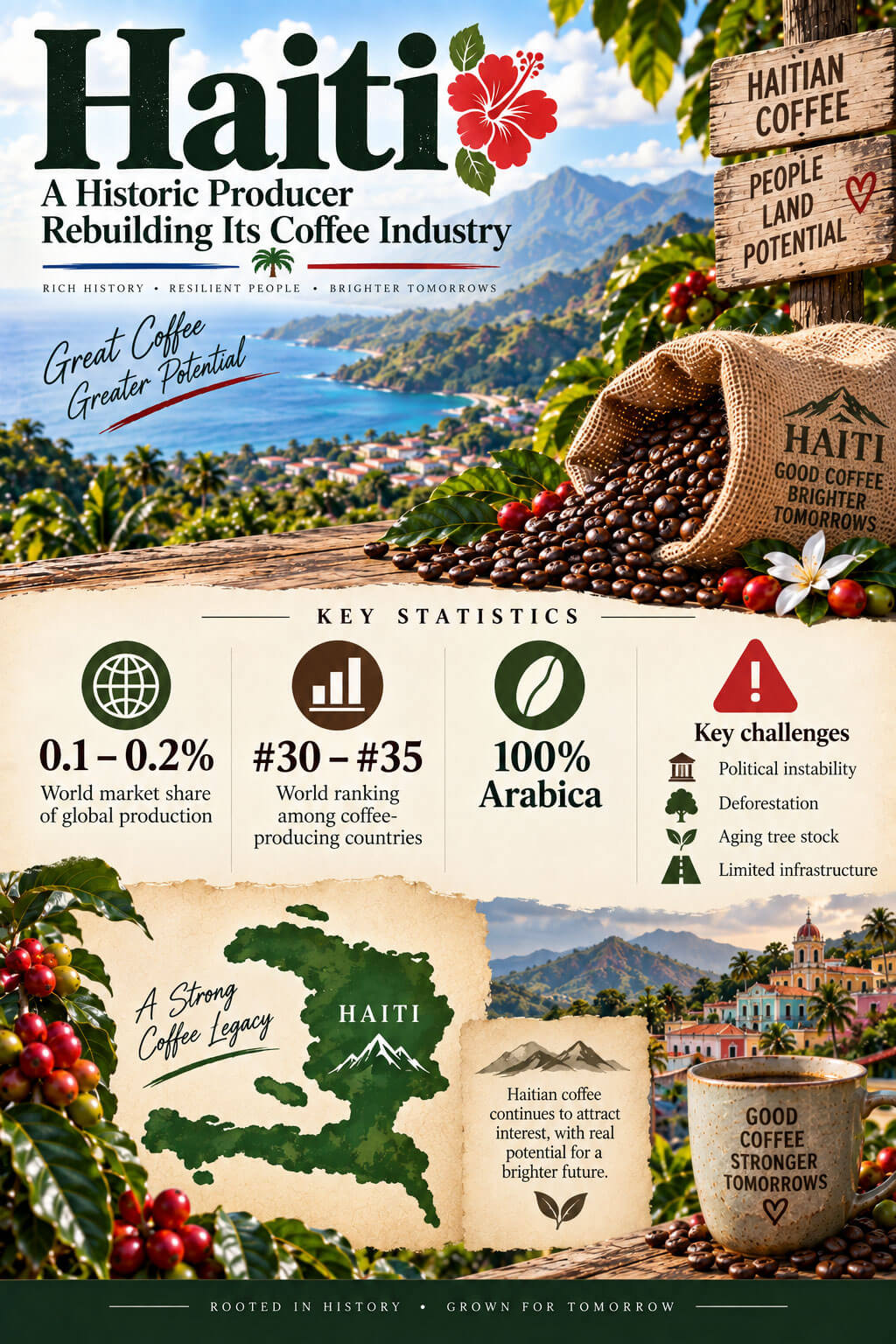
- World market share: Roughly 0.1–0.2% of global production
- World ranking: Generally in the 30th–35th range
- Coffee type: 100% Arabica
- Challenges: Political instability, deforestation, aging tree stock, and limited infrastructure have suppressed output well below the country’s historical potential
Despite decades of decline, Haiti retains meaningful long-term potential as a coffee-producing country. Specialty roasters and development organizations have periodically invested in replanting programs and cooperative structures, aiming to revive export volumes and improve farmer incomes. Haitian coffee’s flavor profile — bright acidity balanced with heavier body — continues to attract niche interest from specialty buyers, even though supply remains inconsistent.
Cuba: A Once-Dominant Producer Still Recovering
Cuba’s coffee industry tells a similar story of historic strength followed by long decline, largely tied to decades of trade restrictions, aging infrastructure, and limited access to modern agricultural inputs.
Key statistics:
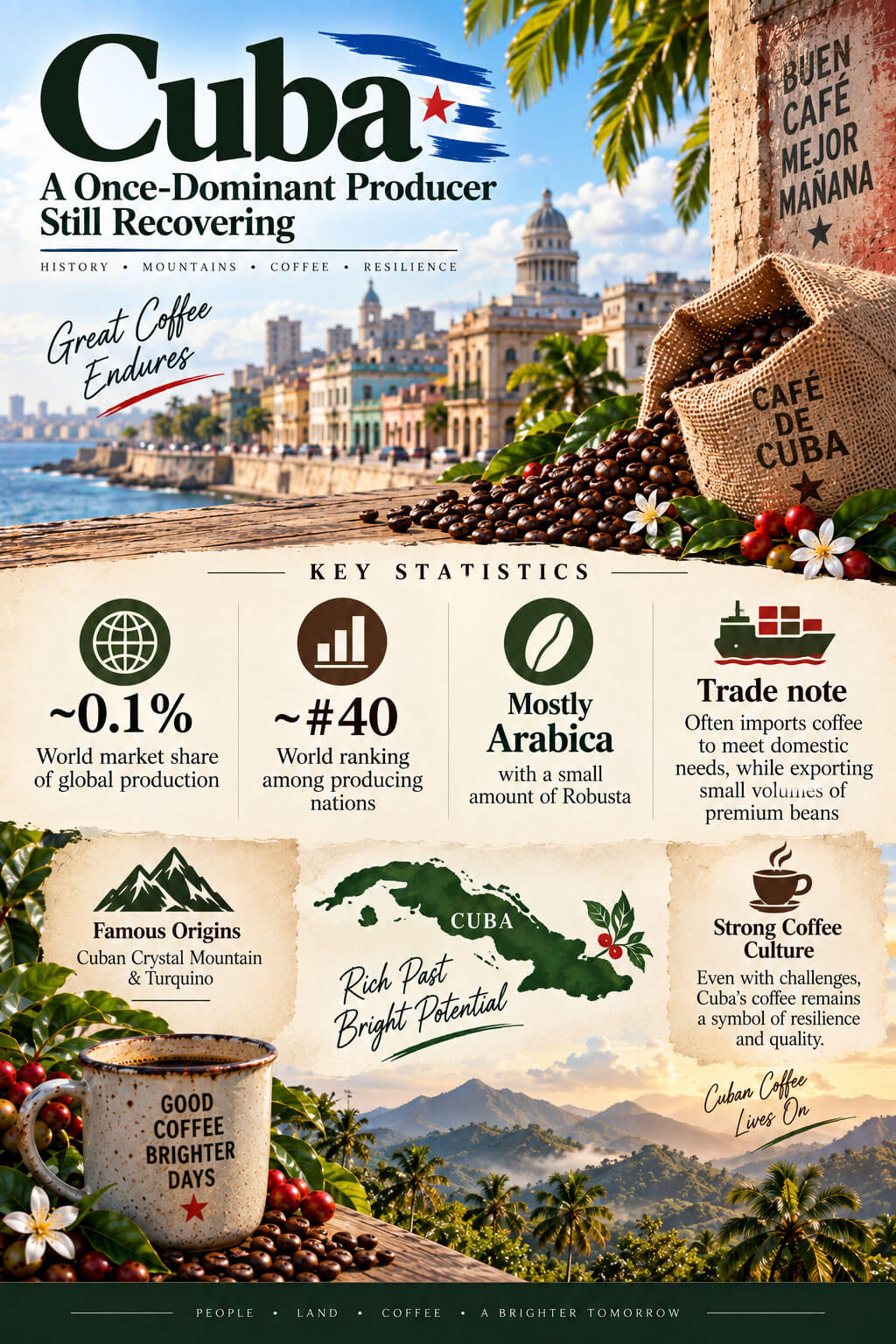
- World market share: Approximately 0.1% of global production
- World ranking: Roughly 40th among producing nations
- Coffee type: Nearly all Arabica, with a small amount of Robusta
- Trade note: Cuba has periodically needed to import coffee to meet domestic rationing requirements, even while exporting small volumes of premium beans like Cuban Crystal Mountain and Turquino
Cuban coffee, grown primarily in the Sierra Maestra mountains, remains tightly controlled by state agricultural policy, which limits the kind of private investment and modernization that has helped other origins expand. Still, Cuba’s coffee-growing regions retain excellent natural growing conditions, and any future policy shifts could meaningfully change the country’s output trajectory.
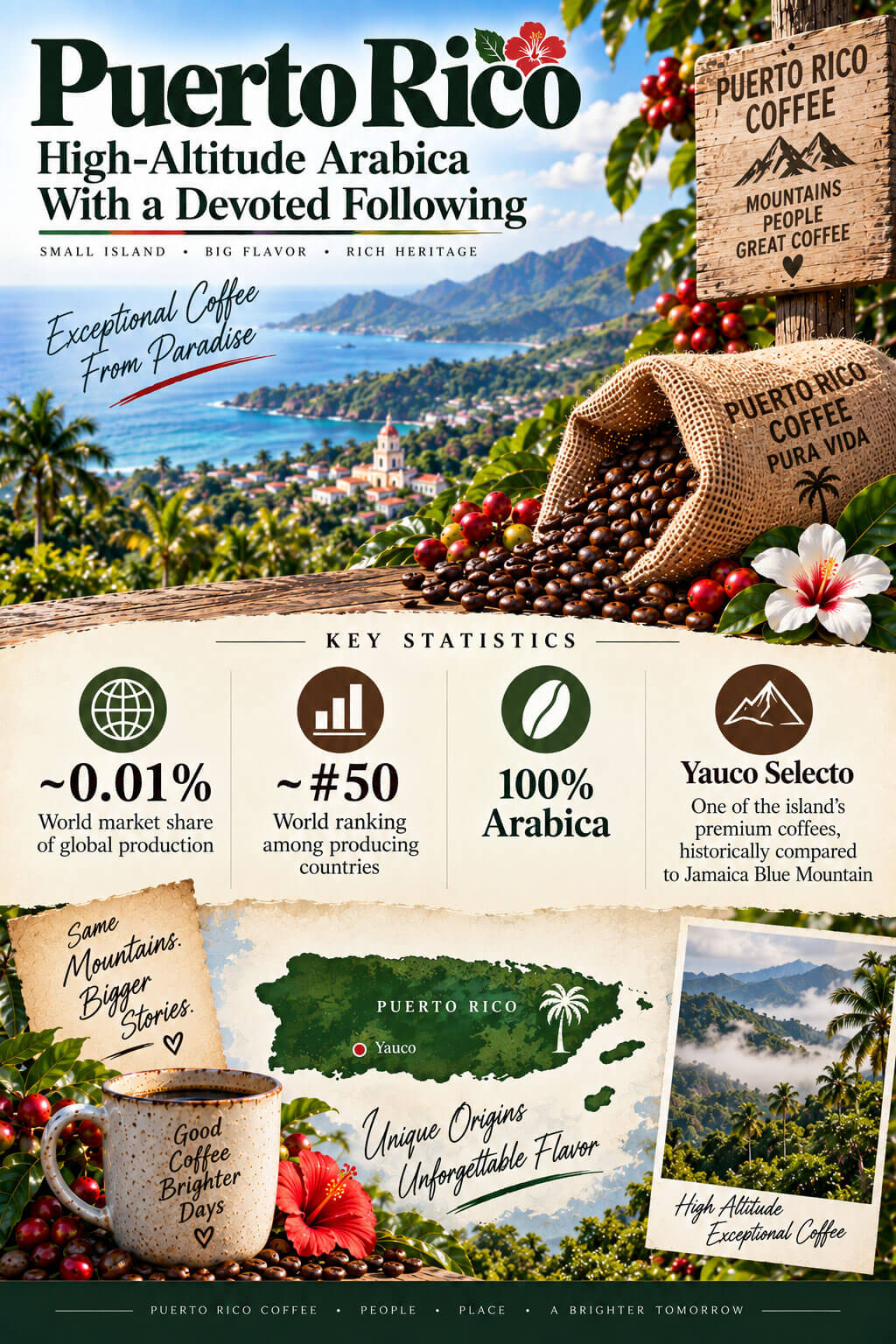
Puerto Rico: High-Altitude Arabica With a Devoted Following
Puerto Rico rounds out the major Caribbean coffee producers, with a small but historically respected industry centered on high-altitude Arabica varieties like Bourbon and Caturra.
Key statistics:
- World market share: Around 0.01% of global production
- World ranking: Generally in the low 50s among producing countries
- Coffee type: 100% Arabica
- Notable varieties: Puerto Rico’s Yauco Selecto is considered one of the island’s premium designations, historically compared favorably to Jamaica Blue Mountain
Puerto Rico’s coffee sector has faced repeated setbacks from hurricanes — most notably Hurricane Maria in 2017 and subsequent storms — which damaged farmland and reduced the available agricultural workforce. As a U.S. territory, Puerto Rico’s coffee industry also competes directly with mainland U.S. coffee demand, and much of its harvest is consumed domestically rather than exported, similar to the Dominican Republic’s model.
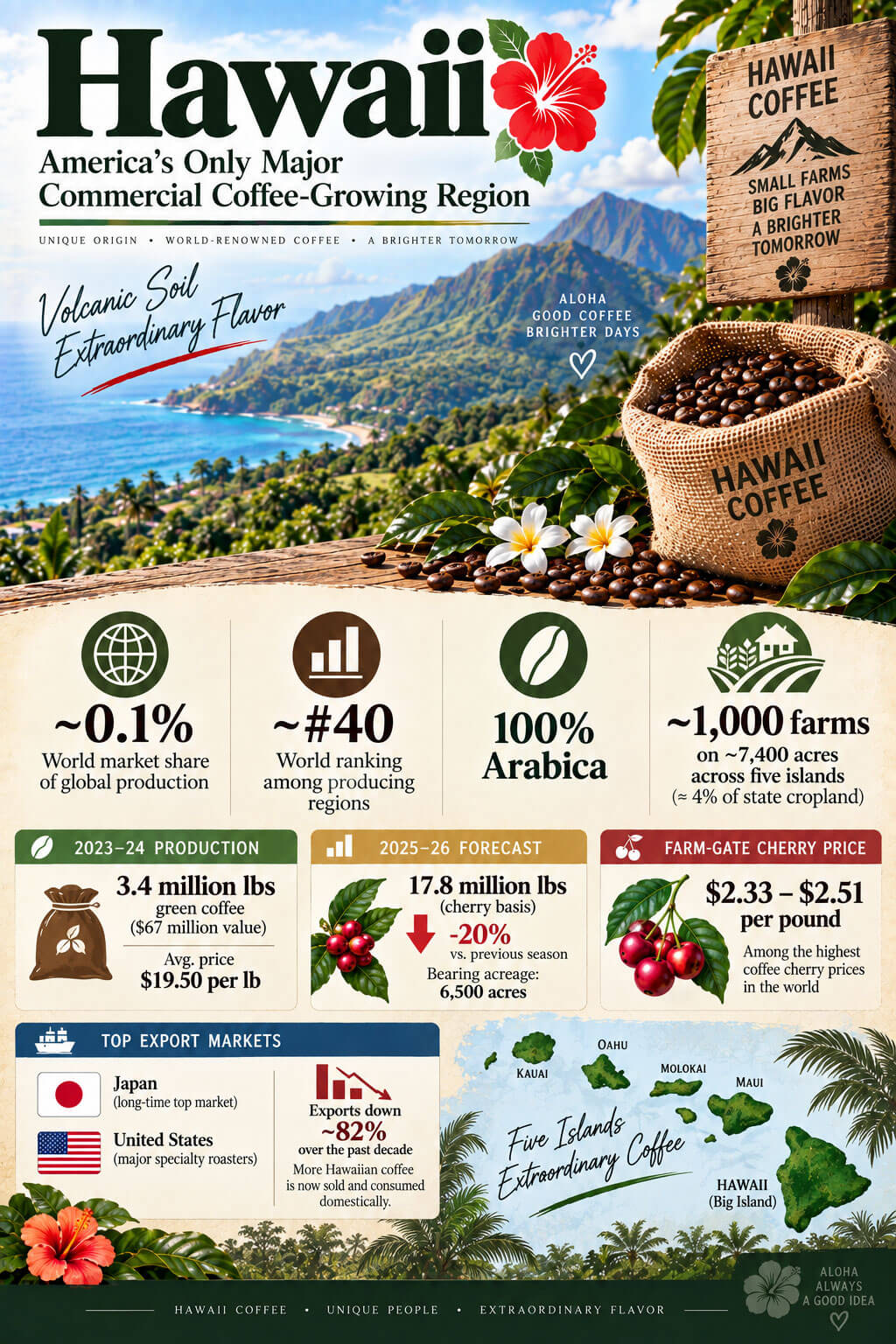
Hawaii: America’s Only Major Commercial Coffee-Growing Region
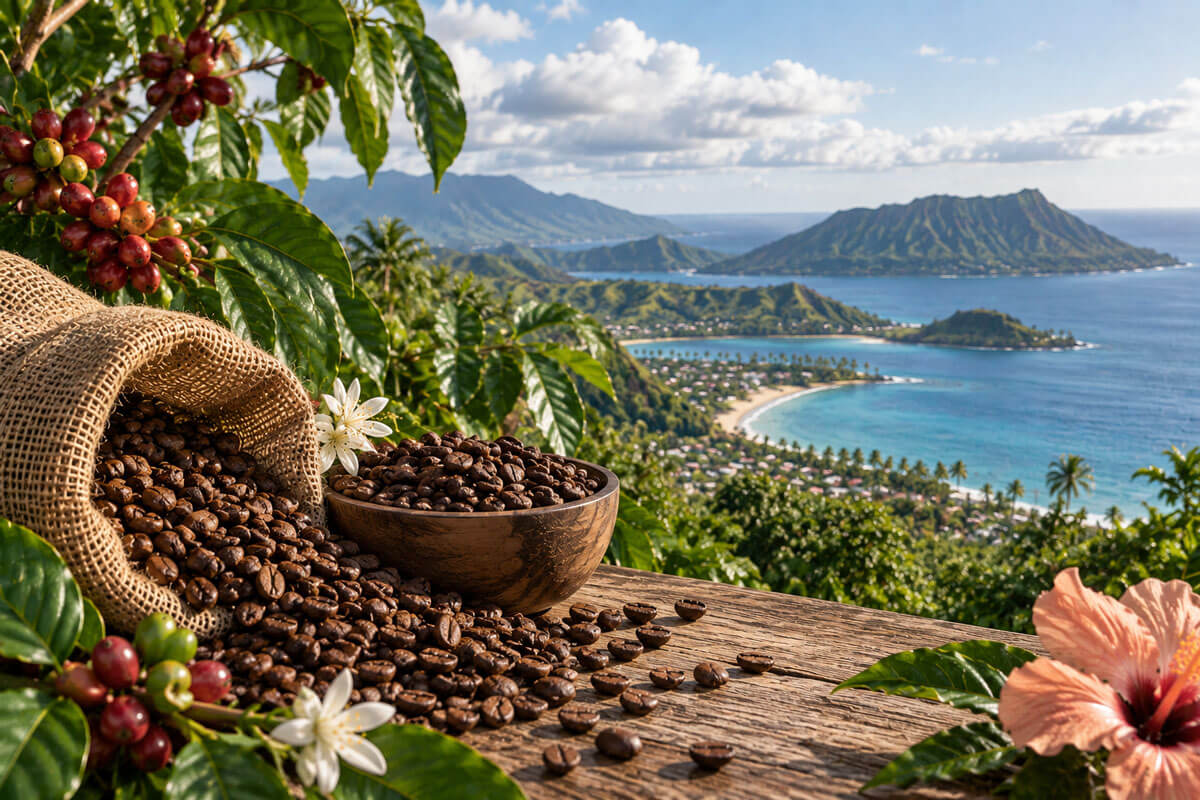
Hawaii stands apart from the Caribbean producers geographically, but it shares the same fundamental story: tiny global market share, outsized reputation, and premium pricing driven by isolation, volcanic soil, and legally protected regional names like Kona.
Key statistics (2023–2024 and 2025–26 seasons):
- World market share: Approximately 0.1% of global coffee production
- World ranking: Roughly 40th among producing regions worldwide
- Coffee type: 100% Arabica
- Farms: Approximately 1,000 coffee farms operating across roughly 7,400 acres on five Hawaiian islands (representing about 4% of the state’s total cropland)
- 2023–24 production: Green coffee production totaled 3.4 million pounds, valued at $67 million, at an average price of $19.50 per pound
- 2025–26 forecast: Utilized production forecast at 17.8 million pounds (cherry basis), down about 20% from the previous season, with bearing acreage falling to 6,500 acres
- Farm-gate cherry price: Around $2.33–$2.51 per pound, among the highest coffee cherry prices anywhere in the world
- Top export markets: Historically strong demand from Japan and mainland U.S. specialty roasters, though 2024–25 saw green coffee export volumes fall sharply — down roughly 82% over the past decade — as more Hawaiian coffee is now sold and consumed domestically
Hawaii’s coffee industry is genuinely unique among coffee-producing countries (or, in this case, coffee-producing U.S. states) because it operates under U.S. labor and environmental regulations, giving it far higher production costs than any competing origin. That’s a major reason why Hawaii coffee, and Kona coffee in particular, carries some of the highest per-pound prices in the world — reportedly up to $60 per pound at retail for authentic 100% Kona beans.
Kona coffee is also one of the most frequently counterfeited coffees on the market. Because “Kona blend” products can legally contain as little as 10% actual Kona-grown beans while still carrying the name, consumers are strongly advised to look for “100% Kona” labeling and certification seals to ensure authenticity. Hawaii’s Department of Agriculture has tightened labeling and disclosure requirements in recent years specifically to combat this widespread mislabeling problem.
Beyond Kona, Hawaii also produces smaller volumes of specialty coffee from the Ka’ū and Puna districts on the Big Island, as well as Maui, Oahu, Kauai, and Molokai — regions that have increasingly earned their own specialty cupping scores above 85 points on the Specialty Coffee Association scale, putting them on par with some of the world’s most celebrated origins.
Comparing the Caribbean and Hawaii Coffee Industries
| Region | World Market Share | Coffee Type | Standout Feature |
|---|---|---|---|
| Jamaica | ~0.01% | 100% Arabica | Blue Mountain, GI-protected |
| Dominican Republic | ~0.2–0.3% | 100% Arabica | Largest Caribbean volume producer |
| Haiti | ~0.1–0.2% | 100% Arabica | Historic 18th-century powerhouse |
| Cuba | ~0.1% | ~100% Arabica, some Robusta | State-controlled production |
| Puerto Rico | ~0.01% | 100% Arabica | Yauco Selecto premium designation |
| Hawaii | ~0.1% | 100% Arabica | Highest farm-gate prices worldwide |
Across all six regions, a clear pattern emerges: every single one of these coffee-producing countries relies almost exclusively on Arabica beans, prized for their smoother, more complex flavor compared to the higher-caffeine, more bitter Robusta variety that dominates cheaper commercial blends from Vietnam and Brazil. This shared commitment to Arabica-only production is a major reason these origins consistently command premium pricing, even when their total output is statistically negligible on the world stage.
What’s Driving Change in These Coffee-Producing Countries
Several forces are reshaping production across both the Caribbean and Hawaii heading into the second half of this decade:
- Climate volatility. Hurricanes have repeatedly disrupted Jamaica, Puerto Rico, and the Dominican Republic in recent years, while drought and unpredictable weather have hit Hawaii’s harvests.
- Labor costs. Hawaii’s coffee industry, bound by U.S. minimum wage and labor law, faces production costs far above any Caribbean competitor, pushing prices even higher.
- Counterfeiting and mislabeling. Both Jamaica Blue Mountain and Kona coffee face ongoing battles against blended products that dilute their premium reputation, prompting stricter labeling laws in both regions.
- Shrinking export volumes. Several of these origins — notably Hawaii and Puerto Rico — are seeing more of their harvest consumed domestically or regionally rather than exported, tightening global availability even further.
- Rising specialty demand. Despite production challenges, global appetite for rare, traceable, single-origin coffee continues to grow, which has helped sustain premium pricing even as raw output declines.
Final Thoughts
The coffee-producing countries of the Caribbean, alongside Hawaii, will likely never compete with Brazil, Vietnam, or Colombia on volume. Combined, they still represent well under 1% of the world’s coffee supply, largely unchanged since the International Coffee Organization’s earliest detailed regional breakdowns over a decade ago. But volume was never really the point.
What Jamaica, the Dominican Republic, Haiti, Cuba, Puerto Rico, and Hawaii offer instead is scarcity, story, and terroir — volcanic soil, high-altitude microclimates, legal origin protections, and decades (in some cases centuries) of cultivation history. For coffee drinkers willing to pay a premium, these small coffee-producing countries continue to deliver some of the most sought-after, expensive, and carefully guarded beans in the world.
Statistics referenced in this article are drawn from the International Coffee Organization (ICO), USDA Foreign Agricultural Service and National Agricultural Statistics Service (NASS), the Jamaica Coffee Exporters Association, and the Hawaii Department of Agriculture, reflecting the most recently published harvest data as of 2025–2026.