
Can Coffee Affect Your Breastfed Baby?
If you are a new mom, coffee has probably become something close to a survival tool, and the question “does caffeine pass into breast milk?” has likely crossed your mind more than once while reaching for a mug after a long night of feedings. The short answer is yes: caffeine does pass into breast milk, but in surprisingly small amounts, and for most healthy, full-term babies a moderate coffee habit does not cause noticeable problems. Even so, it is completely natural to wonder whether your morning cup could be the reason your little one fights naps or wakes at 2 a.m., and that question deserves a clear, evidence-based answer rather than a vague “everything in moderation.”
In this guide you will learn exactly how caffeine travels from your cup into your milk, how long it stays there, and why newborns handle it differently than adults. We will look at what the research actually says about coffee and your baby’s sleep, how much caffeine major health organizations consider reasonable, and which practical habits make it easier to enjoy your coffee without second-guessing every sip. You will also find a list of common mistakes to avoid, the signs that your baby may be sensitive, and answers to the questions nursing parents ask most often.
Quick answer
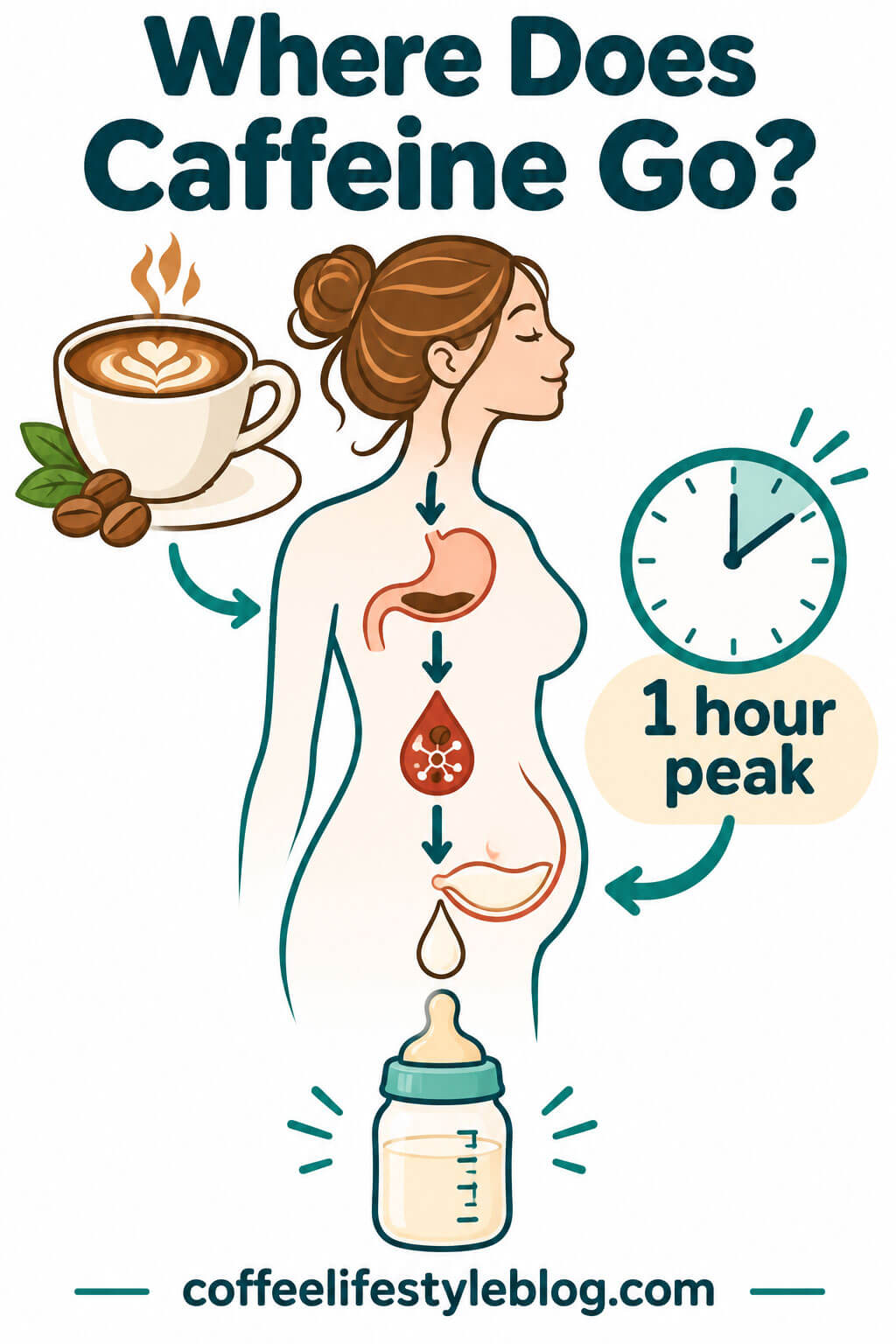
Yes, caffeine passes into breast milk, usually peaking about an hour after you drink it, but only around 1% of what you consume reaches your baby in most studies. Up to about 300 mg a day (roughly two to three cups of coffee) is generally considered acceptable by the CDC, and research so far has not shown that moderate intake reliably disrupts infant sleep, although very young babies and very high intakes are the exceptions worth watching.

How Caffeine Gets Into Breast Milk
Caffeine is a small, fat- and water-soluble molecule, which means it moves easily from your bloodstream into your milk, much as it moves into saliva and other body fluids. According to the National Library of Medicine’s LactMed database, caffeine appears in breast milk rapidly after you ingest it, and the concentration in your milk tends to rise and fall in step with the concentration in your blood. That is why the timing of your coffee matters a little more than most parents realize, a point we will return to in the tips section.
How Much Actually Reaches Your Baby?
One of the best-known studies in this area, published in Pediatrics in 1984, followed 15 nursing mothers who drank coffee or tea containing between 35 and 336 mg of caffeine. The researchers found that peak milk levels ranged from about 2.1 to 7.2 mg per liter in the women who had detectable caffeine, while the four mothers who consumed less than 100 mg had none that could be measured. Caffeine was not detectable in the urine of any of their babies during the collection period. Popular summaries of this work usually put the transfer at roughly 1% of the maternal dose, with estimates ranging from about 0.06% to 1.5%.
Other studies paint a slightly more nuanced picture, and it is worth knowing about them. When researchers adjust for body weight, which matters because a newborn is so much smaller than an adult, one pharmacokinetic study estimated that an exclusively breastfed infant would receive about 7% of the mother’s weight-adjusted caffeine dose, and LactMed notes similar figures of around 9% to 10% in other small studies. In other words, your baby is exposed to a small fraction of what you drink, but that fraction is not zero and it is not trivial for a tiny body that clears caffeine slowly.
When Does Caffeine Peak, and How Long Does It Last?
Caffeine usually reaches its highest level in breast milk about one hour after you drink it, and in the study of 15 mothers the average half-life of caffeine in milk was about 6.1 hours. A separate single-dose study reported a milk half-life closer to 7 hours, while a case report of a mother who drank an 80 mg espresso found that caffeine was undetectable in her milk after 24 hours. Taken together, these numbers mean that a single cup of coffee leaves your milk gradually over the course of a day rather than all at once, and that levels build up slightly if you sip coffee repeatedly from morning to evening.
Researchers have also found that caffeine is not the only compound in play. A 2022 analysis of milk from 100 women in Poland found a strong link between a mother’s caffeine intake and the levels of caffeine and its breakdown product paraxanthine in her milk, and it also detected smaller amounts of theobromine and theophylline, which are related stimulant compounds. These metabolites peak later than caffeine itself, which is one reason the effects of a cup of coffee can linger longer than the caffeine alone would suggest.
Why Babies Process Caffeine Differently Than Adults
The main reason caffeine in breast milk gets so much attention has nothing to do with the amount in the milk and everything to do with the baby’s liver. Adults clear caffeine using an enzyme system that newborns have barely begun to develop, so caffeine clearance is very low in preterm and newborn infants and only reaches adult values at around 3 to 5 months of age, as a review of neonatal exposure to drugs in breast milk explains. As a result, a very young baby may have caffeine levels that stay elevated for much longer than yours do, and preterm infants may reach blood levels similar to their mothers’ even from small amounts.
Your own body changes too, which is a nice piece of encouraging news. During late pregnancy the half-life of caffeine in the mother is much longer than in a non-pregnant woman, but it returns to normal within the first week after delivery, so you clear caffeine faster postpartum than you did in the third trimester. Smoking speeds up caffeine clearance in adults as well, while individual genetics play a role in how strongly any one person responds, which helps explain why two mothers drinking the same amount of coffee can report completely different experiences.
Can Coffee Affect Your Baby’s Sleep? What the Research Shows
This is the question most parents really want answered, and the honest answer is that the evidence is reassuring but not perfect. A 2018 systematic review in the Swiss Medical Weekly concluded that high-quality data on maternal caffeine intake and its effects on the breastfed child are still limited, which is why recommendations vary from one organization to another. That said, several individual studies give a useful picture of what to expect.

The Large Cohort Study: A Small Signal, Not a Proven Link
The biggest study on sleep followed 885 infants in Brazil and asked mothers about their caffeine intake and their baby’s night waking at three months. Researchers found that infants whose mothers consumed more than 300 mg of caffeine a day had slightly more nighttime awakenings, but the difference was not statistically significant, and the authors concluded that a limit of 300 mg a day is reasonable. In plain language, there was a hint of an effect at higher intakes, but it was not strong enough to prove that coffee was the cause.
The Randomized Trial: No Change in Sleep at 500 mg
A more controlled experiment came from a double-blind study in which 11 nursing mothers drank five cups of decaffeinated coffee daily for five days, with or without an additional 500 mg of caffeine. Their babies were about 47 days old on average, and the researchers measured heart rate and sleep time, finding no effect of the added caffeine on either. It was a small trial and the babies’ feeding patterns were not fully described, so it cannot settle the question, but it suggests that even a fairly high dose does not automatically disrupt sleep.
Case Reports at Very High Intakes
The reports that do describe unsettled babies tend to involve very large amounts. LactMed summarizes cases of jitteriness, irritability, and poor sleep in infants whose mothers consumed the equivalent of 10 or more cups of coffee a day, including a mother who also drank several bottles of cola daily, and one case of irritability linked to regular maternal consumption of yerba mate. In most of these cases the symptoms improved after the mother cut back, which supports a genuine dose-related effect at the extreme end of the range.
Other Effects Worth Knowing About
Sleep is not the only outcome researchers have looked at. A small survey of 56 exclusively breastfeeding mothers suggested that intakes above 130 mg a day were associated with a lower weight percentile in babies, although the authors and LactMed both stress that this needs confirmation in larger studies. An older study from Costa Rica found that drinking more than about 450 mL of coffee daily was linked to lower iron levels in breast milk and in infants, which is a good reminder to keep an eye on your iron intake if you are a heavy coffee drinker. As for the popular belief that coffee reduces milk supply, LactMed reports that there is no scientific information to support it.
How Much Caffeine Is Safe While Breastfeeding?
Different authorities draw the line in slightly different places, which can be confusing. The CDC states that about 300 mg of caffeine a day or less, roughly two to three cups of coffee, usually does not adversely affect breastfed babies. The European Food Safety Authority takes a more conservative view and, in its 2015 scientific opinion on caffeine, considers 200 mg a day a likely safe level for lactating women. LactMed suggests that a limit of 300 to 500 mg might be safe for most mothers while also noting that lower intake is preferable for the mothers of preterm and very young infants.
For comparison, the U.S. Food and Drug Administration says that 400 mg a day is generally not associated with negative effects for most healthy adults who are not pregnant or nursing, so the nursing guidance is more cautious precisely because of the baby’s slower metabolism. A practical way to think about it is that two cups of home-brewed coffee sit comfortably within every guideline, three cups fit within the CDC’s guidance, and anything beyond that is worth discussing with your doctor or lactation consultant.
Where Caffeine Hides
The amount of caffeine in a cup varies enormously, and a large coffeehouse drink can contain far more than a standard mug at home. Brewed coffee generally falls somewhere between about 60 and 200 mg per 8-ounce cup depending on the bean, roast, and brewing method, while black tea, cola, energy drinks, matcha, chocolate, and some pain relievers all contribute their own share. LactMed notes that other caffeine sources such as cola, energy drinks, yerba mate, and guarana have similar dose-related effects, and that chocolate also contains theobromine, a related compound that can pass into milk. If you are counting, remember that decaf is not entirely caffeine-free, but it typically provides only a few milligrams per cup, which makes it an easy swap for your second or third cup of the day.
Practical Tips for Enjoying Coffee While Nursing
You do not need to give up coffee to protect your baby’s sleep, but a few small habits can make your intake more comfortable and more predictable. These tips are based on what the research says about peak levels and clearance times rather than on strict rules, so feel free to adapt them to your own routine.
- Drink your coffee right after or while you nurse. Because milk caffeine peaks about an hour after you drink, having coffee immediately after a feeding gives your body time to start clearing it before the next one, particularly useful during the day when your baby feeds every two to three hours.
- Spread your intake across the day. One large drink delivers a bigger spike than two smaller ones, so splitting your caffeine into smaller servings keeps milk levels lower and steadier.
- Try half-caf blends. Mixing regular and decaf beans lets you keep the ritual and the flavor while cutting your total intake, and it works well as a gradual step down if you have been drinking more than three cups.
- Stop caffeine early in the afternoon. Since milk caffeine has a half-life of several hours, a late-day coffee can still be present during your baby’s evening feedings and may also interfere with your own much-needed sleep.
- Pair coffee with food and water. A breakfast with protein and a glass of water next to your mug keeps you hydrated and steadies your energy, which means you may not need that extra cup at all.
- Label pumped milk if you are pumping around coffee time. If your baby is sensitive, you can save milk pumped during your caffeine-free hours for the evening, and breast milk storage bags with date labels make it easy to keep track.
Pro tip: If you want to stretch your caffeine budget, try swapping one regular cup for a quality decaf ground coffee or a decaffeinated black tea, and keep it hot in an insulated travel tumbler so you can actually finish it between feedings.

Common Mistakes to Avoid
The most frequent mistake is blaming coffee for every fussy night. Newborn sleep is naturally short and fragmented, because tiny stomachs need frequent feeds and sleep cycles take months to mature, so waking every two or three hours is normal whether or not you drink caffeine. Growth spurts, cluster feeding, gas, reflux, teething, and developmental leaps are all far more common causes of unsettled nights than a moderate coffee habit. If you suspect caffeine, treat it as a hypothesis to test rather than a conclusion.
The second mistake is pumping and dumping after a cup of coffee. Caffeine leaves your milk as it leaves your blood, which means discarding milk does not speed up the process and only wastes something valuable. The third is overlooking hidden caffeine, because it is easy to stay within a three-cup limit on paper while adding an energy drink, a pre-workout powder, a few squares of dark chocolate, or a late-afternoon iced tea that quietly push your daily total well above 300 mg. The fourth is quitting cold turkey if you are a regular drinker, since sudden withdrawal can cause headaches and fatigue at a time when you can least afford them, so cutting back gradually is kinder to your body.
Signs Your Baby May Be Sensitive to Caffeine
Some babies seem more affected than others, and this is most likely to show up in the early weeks. Signs that may suggest sensitivity include unusual fussiness or irritability, appearing wide-eyed and alert when you would expect drowsiness, jitteriness, and difficulty settling to sleep, particularly within a few hours after you have had caffeine. None of these signs is specific to caffeine, so look for a consistent pattern rather than a single bad night.
If you suspect a connection, a simple experiment can give you a clearer answer. Cut your caffeine to a minimal amount or switch to decaf for about a week, keep a short log of your baby’s sleep and mood, and then reintroduce a small amount to see whether the pattern returns. If your baby’s symptoms do not change, caffeine is probably not the culprit, and you can return to your usual routine with confidence. If the symptoms are severe, if your baby is feeding poorly, or if you have any worry about their health, check in with your pediatrician instead of waiting for the experiment to finish.
Special Situations to Keep in Mind
Parents of newborns and preterm babies have the most reason for caution, since infants in the first weeks clear caffeine very slowly. If your baby was born early or is under about two or three months, aiming for the lower end of the guidelines, around 200 mg a day or less, is a sensible approach, and your pediatrician can advise you based on your baby’s particular situation. As your baby grows, the liver matures and caffeine becomes less of a concern, which is why many mothers find they can relax around the four- to six-month mark.
If you smoke, you will clear caffeine faster, but nicotine brings its own risks for your baby and your doctor can help you plan to quit. And if you are pumping at work, the same timing logic applies: caffeine will show up in the milk you pump about an hour after your cup, but it is only a small amount in each bottle once it is mixed with milk from other sessions. Finally, do not forget your own wellbeing, because very high caffeine intake can cause anxiety, a racing heart, and poor sleep for you, and getting enough rest is one of the best things you can do for your recovery and for your milk supply.
Frequently Asked Questions
Does caffeine pass into breast milk?
Yes. Caffeine appears in breast milk within minutes of ingestion and peaks at around one hour, but the studies reviewed by LactMed suggest that your baby receives only a small percentage of the amount you consume, roughly 1% in many reports and up to about 10% when body weight is taken into account.
How much coffee can I drink while breastfeeding?
The CDC considers up to about 300 mg of caffeine a day, or two to three cups of coffee, acceptable for most breastfeeding mothers, while the European Food Safety Authority uses a more cautious figure of 200 mg. Because cups vary in strength, it helps to check labels and count caffeine from all sources.
Can caffeine in breast milk keep my baby awake at night?
At moderate intakes it appears unlikely. A cohort of 885 infants showed only a small, nonsignificant increase in night waking above 300 mg a day, and a randomized trial found no change in infant sleep time after 500 mg of added caffeine, though individual babies can be more sensitive, especially in the first months.
Should I pump and dump after drinking coffee?
No. Milk caffeine levels decline on their own as your body clears the caffeine, so pumping and dumping does not remove it faster. If you want to lower your baby’s exposure, the better strategy is to time your coffee right after a feeding or to cut back on the total amount.
When is caffeine out of my breast milk?
The half-life of caffeine in milk is roughly four to seven hours in the studies LactMed summarizes, so most of it is gone within about a day. Individual factors such as your metabolism, smoking, and how much you drank all influence the exact timing.
Is decaf coffee safe while breastfeeding?
Generally yes. Decaf contains only a few milligrams of caffeine per cup, which makes it a convenient way to enjoy the taste of coffee throughout the day, although extremely large volumes of any coffee have been reported to cause irritability in rare case reports.
Final Thoughts
For most nursing mothers, a moderate coffee habit and a well-rested baby can coexist. Caffeine does pass into breast milk, but only a small fraction reaches your baby, and the best available research has not shown that two or three cups a day reliably disrupts infant sleep. The groups that deserve extra attention are mothers of preterm and very young newborns and those who consume very large amounts, because those babies clear caffeine slowly and may be more sensitive.
If you take away one practical message, let it be this: keep your total caffeine around 300 mg a day or lower, time your coffee right after feedings, and watch your baby rather than the clock. You know your baby better than any guideline does, so trust your observations, make small adjustments if something seems off, and talk to your pediatrician or a lactation consultant whenever you have doubts. Enjoying your coffee is a perfectly reasonable part of taking care of yourself, and taking care of yourself is part of taking care of your baby.
This article is for general information only and is not a substitute for personalized medical advice. Talk with your pediatrician, doctor, or a certified lactation consultant about caffeine and your baby’s specific needs, especially if your baby was born prematurely or has health concerns.