
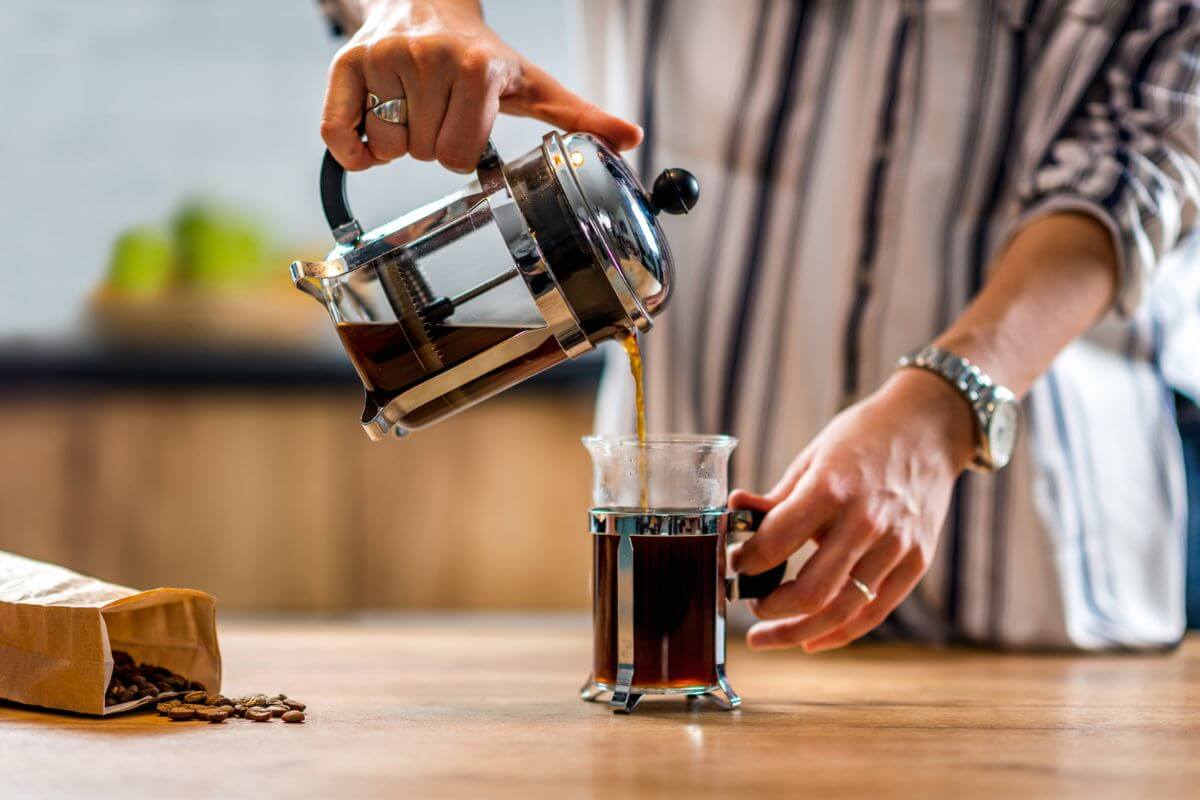
French Press Coffee: The Complete Guide to Brewing Like a Pro
The French press is one of the simplest and most beloved ways to brew coffee at home, and it has earned that reputation for good reason. With nothing more than a glass or steel carafe, a plunger, and a few minutes of patience, you can make a rich, full-bodied cup that rivals what many cafés serve. It needs no electricity and no paper filters, which is why it sits on kitchen counters, camping tables, and office shelves all over the world.
In this guide you’ll learn what a French press is, how it looks and works, and how to use it step by step, along with the gear that really matters, the most common mistakes, cleaning tips, and answers to the questions people ask most often. Halfway through, you’ll also find a short quiz that helps you decide whether this brewer fits your taste and your daily routine.
Quick answer
A French press is a manual coffee brewer that steeps coarsely ground coffee in hot water for about four minutes before a metal mesh plunger pushes the grounds to the bottom. For the best results, use a 1:15 coffee-to-water ratio, water between 195 and 205°F, and a coarse, even grind. The result is a bold, full-bodied cup with a silky texture.

What Is a French Press?
A French press, also called a press pot, plunger pot, or cafetière, is an immersion coffee brewer. In a drip machine or a pour-over cone, water passes quickly through the grounds and into a cup, but in a French press the grounds stay in the water for the entire brew, which gives you full control over how much flavor is extracted. When the timer runs out, you push a plunger fitted with a fine metal mesh down through the pot, and the mesh holds the grounds at the bottom while the coffee stays above it.
The design has a surprisingly long history. A patent filed in Italy in 1929 is often credited as the origin of the modern press, and the idea was refined in France over the following decades before brands such as Bodum helped turn it into a household staple. Almost a century later, the basic principle has barely changed, which says a lot about how well it works.
What Does a French Press Look Like?
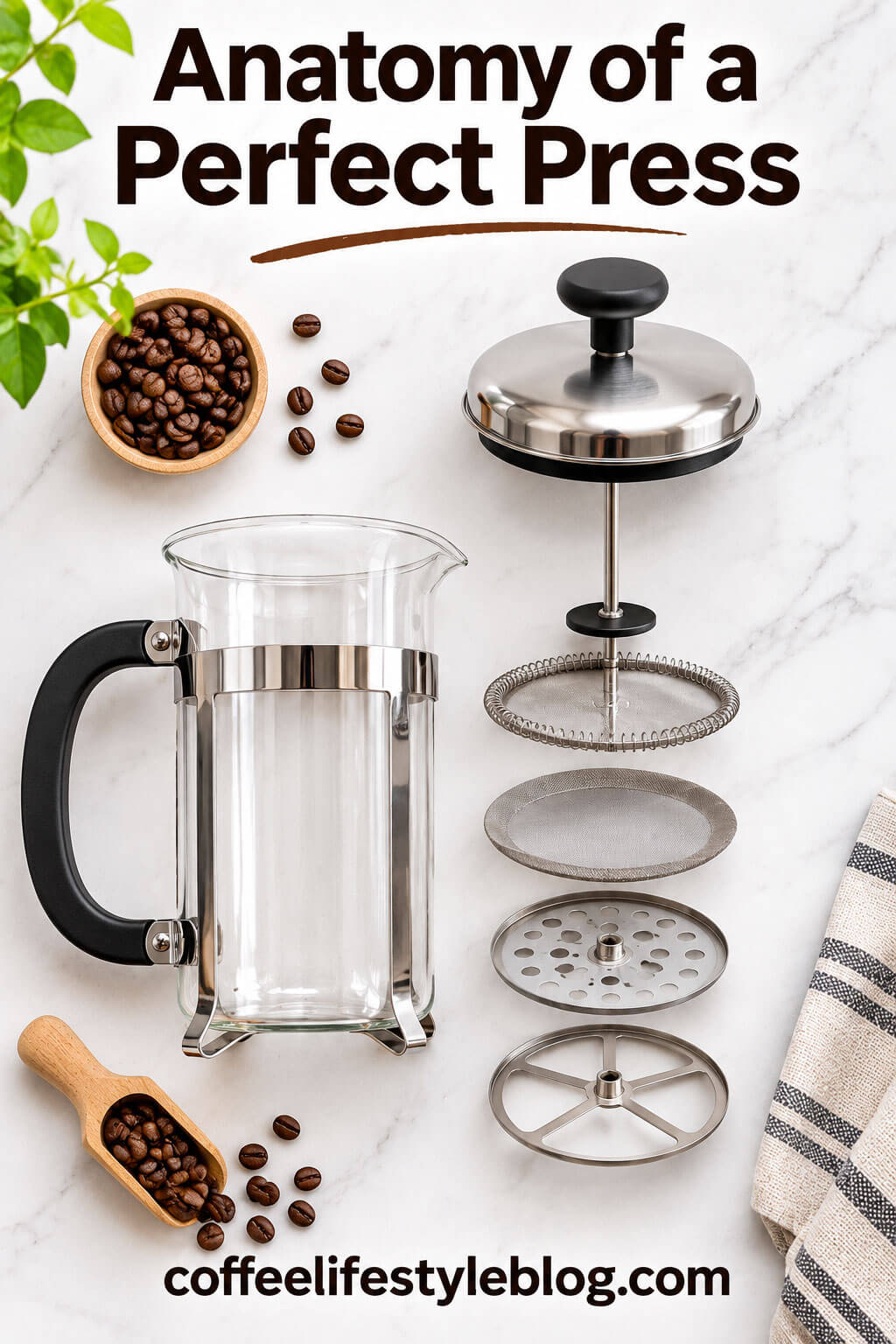
A classic French press is a tall, cylindrical carafe, usually made of heat-resistant borosilicate glass, held in a frame with a handle on one side and a small spout at the top. A lid sits over the opening, and a thin metal rod runs through the center of the lid, ending in a round filter assembly that fits snugly against the inside walls of the carafe. The knob on top of the rod is what you hold when it’s time to press.
The Main Parts
- The carafe: the glass, steel, or ceramic container that holds the coffee and water.
- The lid: it keeps the heat in during steeping and usually has a small pour spout.
- The plunger rod and knob: the part you push down at the end of the brew.
- The filter assembly: a fine stainless steel mesh screen, held in place by a spring-loaded plate, that separates the grounds from the liquid.
- The frame and handle: they protect the carafe and keep your hand away from the hot surface.
Sizes and Materials
French press sizes are labeled in “cups,” but each cup is only about 4 ounces, so the numbers can be misleading. A 3-cup (12-ounce) press suits one person, a 4-cup (17-ounce) press makes about two small mugs, the popular 8-cup (34-ounce) press serves two to four people, and a 12-cup (51-ounce) press is better for a crowd.
Glass is the most common material because it lets you watch the brew, but it is fragile and loses heat quickly. Double-wall stainless steel presses are nearly unbreakable and keep coffee hot far longer, which makes them a great choice for busy kitchens, while ceramic models look beautiful and hold their temperature well. Lightweight plastic or insulated travel presses are best for camping, road trips, and the office.
How a French Press Works and Why It Tastes Different
The secret behind the French press flavor is the combination of full immersion and a metal filter. Because every ground is surrounded by water for several minutes, the extraction is even and forgiving, and you don’t have to worry about pouring technique the way you do with a pour-over. Paper filters trap most of the natural coffee oils and tiny particles, but a metal mesh lets them through, so the cup you pour has a heavier body, a richer mouthfeel, and more pronounced flavors.
The trade-off is that the cup is less clear and slightly cloudier, with a bit of fine sediment at the bottom. Unfiltered coffee also contains more of a natural compound called cafestol, and research suggests that very large amounts of unfiltered coffee may raise LDL cholesterol in some people, so anyone with cholesterol concerns should mention it to their doctor. For most people who enjoy a couple of cups a day, the French press remains a perfectly pleasant everyday brewer.
What You Need to Brew Great French Press Coffee
The beauty of this method is how little equipment it requires. Besides the press itself, which is easy to find in a French press coffee maker search at almost any price, the biggest improvements come from fresh beans and a good grinder. Starting with whole bean coffee and grinding it just before brewing preserves flavors that disappear within minutes of grinding.
A burr coffee grinder is worth the investment because it produces uniform coarse particles, while cheap blade grinders create a mix of dust and boulders that leads to bitter, muddy coffee. A gooseneck kettle with temperature control makes it easy to hit the right water temperature, and a digital coffee scale with a timer takes the guesswork out of measuring. If you often make more than you drink right away, an insulated thermal carafe keeps the extra coffee hot without letting it turn bitter on the grounds.
How to Make French Press Coffee Step by Step
A reliable starting point is a 1:15 ratio, meaning 1 gram of coffee for every 15 grams of water. For example, 30 grams of coffee and 450 grams (about 15 ounces) of water make roughly two mugs. Once you’ve tried this baseline, you can move toward 1:14 for a stronger cup or 1:17 for a lighter one.
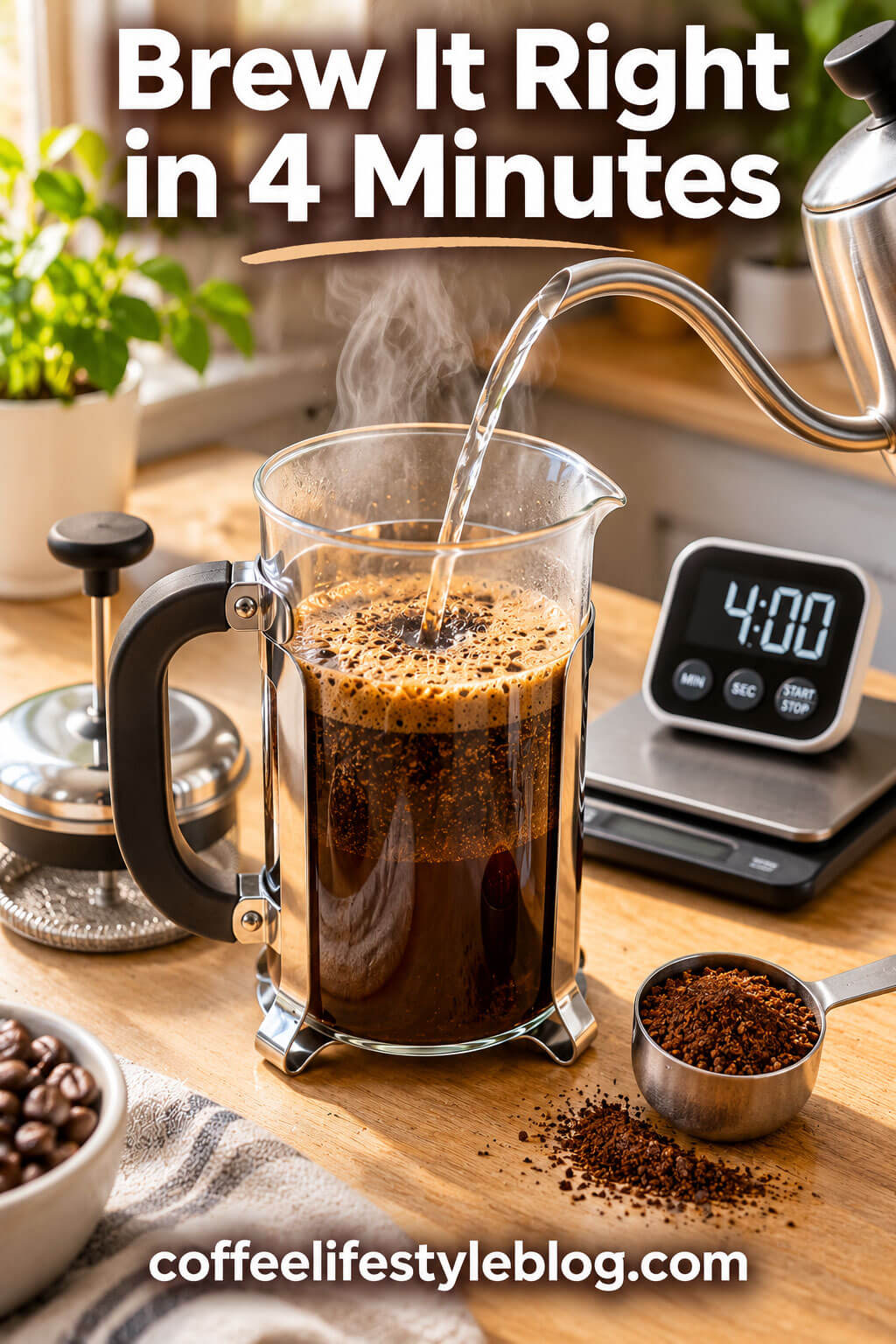
- Heat the water. Aim for 195 to 205°F. If you don’t have a thermometer, bring the kettle to a boil and let it rest for 30 to 45 seconds so the water is no longer scalding.
- Preheat the press. Rinse the carafe with a little hot water and pour it out, which keeps the brew from cooling down too quickly.
- Grind and measure. Weigh out your beans and grind them coarse, about the size of sea salt or coarse breadcrumbs, then pour the grounds into the press.
- Add water and let it bloom. Start your timer and pour just enough water to wet all the grounds, wait about 30 seconds so trapped gases can escape, and then add the rest of the water.
- Stir gently and steep. Give the surface one slow stir, place the lid on with the plunger pulled up, and let the coffee steep for four minutes.
- Press slowly. Push the plunger down in a steady motion over about 20 to 30 seconds, and stop if you feel strong resistance instead of forcing it.
- Serve right away. Pour all the coffee out immediately, because the brew keeps extracting as long as it sits on the grounds.
Pro tip: Try the popular “no-plunge” method made famous by coffee expert James Hoffmann. After four minutes, gently stir, skim off the foam, and let the coffee rest for another five to eight minutes before pouring it through the filter without pressing. The cup comes out cleaner, sweeter, and with far less sediment.
Ratios by Press Size
Use these quick measurements at the standard 1:15 ratio, and leave a little room at the top of the carafe so the plunger has space to move:
- 12 oz (3-cup) press: 20 g coffee and 300 g water
- 17 oz (4-cup) press: 30 g coffee and 450 g water
- 34 oz (8-cup) press: 55 g coffee and 825 g water
- 51 oz (12-cup) press: 85 g coffee and 1,275 g water
Common French Press Mistakes to Avoid
Most disappointing French press coffee comes down to a handful of small errors that are easy to fix once you know about them. The single most common one is using a grind that is too fine, because fine particles over-extract, slip through the mesh, and make the cup bitter, gritty, and hard to plunge. The second is using water that is too hot, since water straight from a rolling boil scorches the grounds and brings out harsh flavors.
Another frequent mistake is leaving the coffee in the press after plunging. Pressing stops the grounds from moving, but it doesn’t stop the extraction, so the last cup from a pot that sat for twenty minutes will taste noticeably bitter. A few other habits are worth watching for:
- Measuring by eye. Scoops vary widely, so a scale gives far more consistent results from one morning to the next.
- Plunging too hard or too fast. Forcing the plunger can push fine particles through the filter and, on a glass press, may even cause an accident.
- Skipping the preheat. A cold carafe can drop the brew temperature by several degrees and lead to a flat, sour cup.
- Using stale or very oily beans. Coffee that is several months past its roast date tastes dull no matter how good your technique is.
- Neglecting the filter. Old coffee oils trapped in the mesh turn rancid and quietly spoil every batch that follows.

Tips for Better French Press Coffee
Once the basics feel comfortable, a few small upgrades can take your coffee from good to excellent. Freshness matters most, so buy beans with a roast date printed on the bag, use them within about four weeks, and grind them right before brewing. Using filtered water also helps, because coffee is more than 98 percent water and chlorine or heavy minerals can dull the flavor.
Roast level is a matter of taste, but medium and medium-dark roasts are especially popular in a French press because their chocolate, caramel, and nutty notes shine in a full-bodied brew. Light roasts work well too and can taste wonderfully fruity, although they often benefit from the full four minutes and slightly hotter water.
When the coffee doesn’t taste quite right, let the flavor guide your adjustments. If the cup is sour, thin, or weak, grind a little finer or steep for another 30 seconds. If it tastes bitter, harsh, or dry, go a little coarser or shorten the steep. Change only one variable at a time so you can tell what made the difference, and consider keeping a small notebook of your recipes. If you can’t stand sediment, pour the finished coffee through a paper filter or a fine mesh sieve into your mug for a cleaner result.
Is a French Press Right for You? Take the Quiz
The French press is wonderful, but it isn’t perfect for everyone. If you’re still deciding whether to buy one or whether it’s worth keeping the one in your cupboard, answer the seven questions below to see how well it matches your tastes and habits.
Quick Quiz
Is a French Press Right for You?
Answer 7 quick questions and find out whether this classic brewer fits your taste, routine, and kitchen.
Things to keep in mind
French Press Pros and Cons
The biggest advantages are flavor, simplicity, and value. A French press produces a full-bodied cup, gives you complete control over strength, costs far less than most coffee machines, and has no electronics that can break. It’s also compact and brews anywhere you can heat water, from a cabin to a campsite.
On the other hand, it is slower and messier than an automatic drip machine, it requires a coarse grind that many supermarket bags don’t offer, and it leaves some sediment in the cup. Compared with a pour-over, it is much easier to master but produces a less delicate, less clear cup, and compared with an AeroPress, it makes larger batches but offers fewer ways to experiment. If you value a hands-on ritual and a rich, comforting cup, the trade-offs are easy to live with.
How to Clean and Care for Your French Press
Proper cleaning keeps your coffee tasting fresh and your press working for years. Never rinse a pot full of grounds straight down the sink, because they can clog your drain over time. Instead, scoop the grounds into the trash or compost, swirl a little water in the carafe to loosen the rest, and pour that slurry through a small strainer.
After that, unscrew the plunger and take the filter assembly apart so you can wash every layer of the mesh with warm, soapy water, since oils and fine particles hide between the plates. Many presses have dishwasher-safe parts, but it’s worth checking the manufacturer’s instructions first. Every few weeks, you can soak the parts in a mixture of hot water and baking soda to remove stubborn residue, and the mesh filter should be replaced about once a year or whenever it looks bent or worn. With glass models, avoid sudden temperature changes, such as adding boiling water to a cold carafe, which can cause cracks.
Creative Ways to Use Your French Press
A French press can do much more than make hot coffee. For easy cold brew, combine coarsely ground coffee with cold water at a ratio of roughly 1:8, stir, refrigerate for 12 to 18 hours, then press and dilute the concentrate to taste. It also works beautifully for loose-leaf tea, since the leaves have room to unfurl, and you can even froth warm milk by pumping the plunger up and down in a clean press for about 20 seconds. Finally, a sturdy stainless steel press is a favorite for camping because it brews strong coffee without needing filters, power, or any special equipment beyond a pot of hot water.
Frequently Asked Questions
What grind size is best for a French press?
A coarse grind, similar to sea salt or coarse breadcrumbs, works best. Fine grounds slip through the mesh, over-extract, and make the coffee bitter and muddy.
How long should you steep French press coffee?
Four minutes is the standard steeping time. Steep a little longer for a stronger, heavier cup, or a little shorter if the coffee tastes bitter.
What is the coffee-to-water ratio for a French press?
A ratio of 1:15, which means 1 gram of coffee for every 15 grams of water, is a reliable starting point. Many people adjust it between 1:14 and 1:17 depending on how strong they like their coffee.
Is French press coffee stronger than drip coffee?
Strength depends mostly on how much coffee you use, but French press coffee tastes bolder because the metal filter lets natural oils and fine particles into the cup, which creates a fuller body and richer texture.
Is French press coffee bad for cholesterol?
Unfiltered coffee contains natural compounds called diterpenes, which research has linked to higher LDL cholesterol when large amounts are consumed regularly. If this concerns you, talk to your doctor or consider using a paper filter for part of your daily coffee.
Can you use pre-ground coffee in a French press?
Yes, as long as it is labeled coarse. Standard drip-grind coffee is usually too fine and will produce a bitter, sludgy cup.
Why is my French press coffee bitter or muddy?
The most common causes are a grind that is too fine, water that is too hot, steeping for too long, or leaving the coffee sitting on the grounds after pressing. Adjusting one of these at a time usually solves the problem quickly.
Final Thoughts
The French press proves that great coffee doesn’t have to be complicated. With fresh beans, a coarse and even grind, water just off the boil, and a four-minute timer, you can brew a deeply satisfying cup at home with very little equipment. Pay attention to the small details such as measuring your coffee, plunging slowly, and cleaning the filter, and you’ll quickly notice the difference in every sip.
Whether you’re buying your first press or finally dusting off the one in the back of the cupboard, give yourself a few mornings to experiment and adjust. Before long, you’ll have a recipe that feels like yours, and a morning ritual that’s as rewarding to make as it is to drink.



One Comment